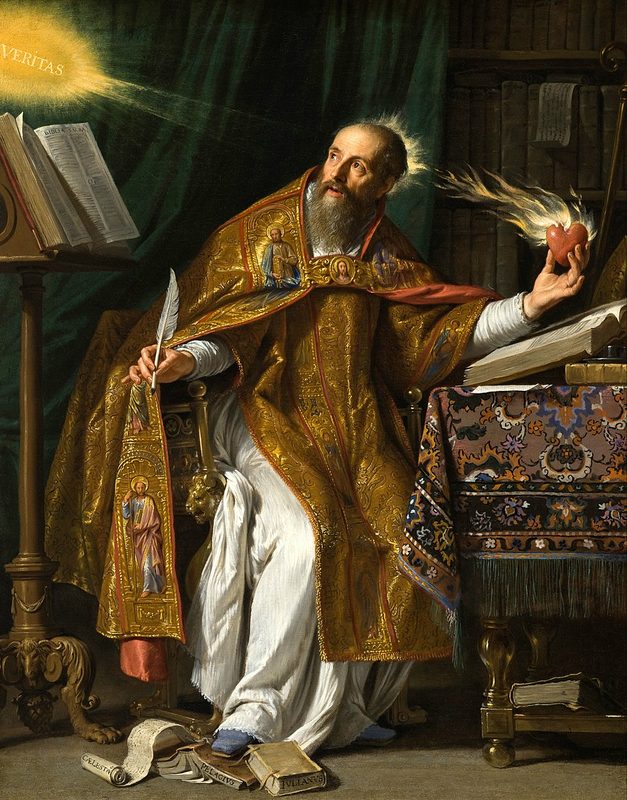
St. Augustine of Hippo
A brilliant, restless seeker who chased pleasure, ambition, and rival philosophies for years — until grace caught him in a garden and made him one of the Church's greatest minds.
He stole the pears for no reason at all. There was a tree heavy with them near the vineyard, and the fruit was not even good, but Augustine and his friends shook it down in the dark and ran — not to eat, for they threw most of it to the pigs, but for the pure thrill of the thing forbidden. He was sixteen, in the small North African town of Thagaste, and already he could feel the two halves of himself pulling apart.
His father, Patricius, was a pagan with ambitions for his clever son. His mother, Monica, was a Christian who wept and prayed over him for the better part of thirty years and would not let him go. They sent him to Carthage to study, and Carthage, he wrote, was a cauldron of unholy loves. He took a mistress, fathered a son he named Adeodatus — "given by God" — and went hunting for wisdom down every road but the one his mother pointed to, falling in for nine restless years with a sect that promised its initiates secret knowledge. Slowly its answers thinned to nothing.
Ambition carried him across the sea to Milan and a chair of rhetoric, and there he went to hear the city's famous bishop, Ambrose, meaning only to study the man's technique. The words got past his guard. The Scriptures he had despised as crude began to open and deepen, and the faith of his childhood started to look like the very thing he had been hunting all along. And still he could not move. He saw what he should do and clung to what he loved, and prayed a prayer he later set down without flinching:
Grant me chastity and self-control — but not yet.
The break came in a garden. Sick of himself, weeping, he threw himself down under a fig tree, and from a house nearby came a child's voice in a kind of sing-song, over and over: Tolle, lege — take it up and read. He took it for a command. He went back to where he had left the book of Paul's letters, opened it, and read the first lines his eye fell on: put on the Lord Jesus Christ, and make no provision for the flesh. He read no further. He did not need to; every shadow of doubt, he said, was swept away.
Ambrose baptized him at the Easter vigil. Soon after, waiting at the port of Ostia for the ship home, he and Monica stood at a window talking late into the evening of what heaven might be, and for one moment, together, they seemed almost to touch it. She died there, content; the prayer of thirty years was answered, and she had no more need of Africa or of anything else.
He had meant to vanish into a quiet life of study. The people of Hippo would not have it; they pressed him into the priesthood and then made him their bishop, and for thirty-four years he preached, settled quarrels, fed the poor, and wrote — the Confessions, in which he told God the whole story aloud, and the City of God, set down while the empire cracked around him. He died in the summer of 430 as the Vandals' siege closed on the city and the smoke of burning towns drifted over the harbor. He had the penitential psalms copied out in large letters and fastened to the wall beside his bed, and he lay looking at them, weeping and praying, until the words and then the light went out.
1The Stolen Pears
There was a pear tree near the vineyard, loaded with fruit that was neither handsome nor sweet. Late one night a gang of restless boys, Augustine among them, went and shook it bare. They were not hungry; they had better pears of their own at home. They ate a little and threw the rest to the pigs. That was the whole of it — and decades later, an old bishop writing his confessions kept circling back to that tree, unable to leave it alone.
What gnawed at him was that there had been no reason. He had not wanted the pears. He had wanted the theft — the laughing, the trespass, the doing of a thing purely because it was forbidden, and the doing of it in company, for he was sure he would never have done it alone. He had loved his own undoing; he had been in love with falling. In a basket of bad fruit flung to the pigs he had glimpsed something about the human heart that all his later learning only confirmed: that it can reach for the wrong thing simply because it is wrong, and call the emptiness freedom.
2Cicero and the Hunger for Wisdom
At nineteen, deep in his rhetoric studies at Carthage, Augustine read a book by Cicero called the Hortensius — now lost — that urged its readers to love and pursue wisdom for its own sake. It set him alight. Overnight the prizes he had been chasing looked cheap, and he burned to find truth itself. He turned to the Scriptures to see whether they held it, and recoiled: after Cicero's polished Latin the old Bible struck him as crude and embarrassing, full of plain talk and unsavory tales, and he put it back down. Hunting instead for a wisdom that flattered his cleverness, he fell in with the Manichees, who promised pure reason, hidden knowledge, and a tidy answer to the question that gnawed at him — where evil comes from — without ever asking him to believe what he could not see.
3Monica's Tears
His mother had been praying for him since before he could refuse her. Monica wanted two things for her son — that he would be chaste and that he would be baptized — and for years she watched him move in the opposite direction, into the arms of a mistress and the errors of the Manichees. She wept over him so long and so hard that she went to a certain bishop and begged him to argue her son out of his heresy. The bishop, who had once been a Manichee himself, refused; the young man was too clever and too proud to be talked down, he said, and would only learn by reading and time. Monica kept pressing, kept weeping, until the bishop, half in exasperation, said the words she carried for the rest of her life:
Go your way; it is not possible that the son of these tears should perish.
When Augustine slipped away by ship to Italy — sailing at night, having lied to her about his plans precisely so she would not follow — she came after him anyway, across the sea, and was there in Milan to see Ambrose's preaching begin to do what no argument of hers ever could.
4Nine Years a Manichee
For close to a decade he was a Manichee — one of their "hearers" — and dazzled his friends with the sect's arguments. He took a concubine, a woman he never names but stayed faithful to for years, and she bore him a son he loved and called Adeodatus, "given by God." He taught rhetoric, first in his home town and then in Carthage, where the students' rioting wore on him. And all the while the Manichee answers, looked at closely, were beginning to crack. For years he had been told that every doubt would be settled once he could put his questions to Faustus, the sect's most famous teacher. When Faustus at last arrived, Augustine found him charming, eloquent — and unable to answer a single hard question. The spell broke. Restless and disillusioned, he resolved to leave Africa for Rome, and from Rome won the prized post of public orator in Milan.
5The Bishop of Milan
In Milan he went, at first only out of professional curiosity, to hear the city's bishop, Ambrose, the most celebrated preacher in the West. Ambrose received him kindly, and Augustine sat beneath the pulpit studying the man's technique — and, almost against his will, absorbing what he said. He had thrown the Scriptures aside as crude; now he heard Ambrose open them, drawing out from beneath the rough surface of the Old Testament a depth he had never dreamed was there. The intellectual walls came down one by one. He read, too, certain books of the Neoplatonist philosophers, which taught him to conceive of God and the soul as realities beyond the reach of the senses, and showed him that evil was no thing at all but a lack, a turning-away from the good. He believed now. He simply could not yet move.
6Ponticianus's Story
What finally broke him open was a story told by a guest. A countryman named Ponticianus, a Christian who held a post at court, came to call, and noticing a volume of St. Paul on the table began to speak of Antony, the monk of the Egyptian desert, whose example had emptied the cities into the wilderness for the love of God. Then he told of two officials of the court who, idling one afternoon, had picked up a life of Antony, read it, and on the spot abandoned their careers and their brides to follow Christ. Augustine sat there flayed. Here were the untaught rising up and seizing heaven, he thought, while he and his clever friends, for all their learning, lay wallowing in their own indecision. Sick of himself, he fled into the garden.
7Take Up and Read
By the late summer of 386 he was at war with himself. He believed, now, that the faith was true; he simply could not bring himself to let go of the life he knew. The wanting and the refusing tore at him until, one afternoon in the garden of the house in Milan, he broke. He fled to the far end under a fig tree and wept like a man whose chest was splitting, crying out to God, "How long? How long? Tomorrow and tomorrow? Why not now?"
And then, from a neighboring house, a child's voice — a boy's or a girl's, he could not tell — began to chant in a kind of game, the same words over and over: Tolle, lege. Tolle, lege. Take up and read. He could think of no children's game with those words. He took it as a command from heaven. He hurried back to the bench where his friend Alypius sat, snatched up the volume of Paul's letters he had left there, and opened it at random, and read the first passage his eyes fell on: not in rioting and drunkenness, not in chambering and wantonness… but put on the Lord Jesus Christ, and make no provision for the flesh. He read no further. He had no need to. A light of certainty flooded his heart, and every shadow of doubt was gone.
8The Font
At the Easter vigil of 387, in Milan, Ambrose baptized him — and with him his dear friend Alypius, and his son Adeodatus, then about fifteen. The boy was extraordinary; Augustine later set down a dialogue recording his son's answers and swore that the brilliance in it was genuinely the child's own, that he had been half-frightened by the gifts God had packed into him. Adeodatus would not live to grow up. He died only a year or two later, still a boy, back in Africa. Augustine, who had given him life out of his own sin, gave thanks through his grief that God had so soon lifted the child out of the world's reach.
9The Window at Ostia
The conversion won, the baptism received, Augustine and Monica set out for home to Africa and stopped at Ostia, the port of Rome, to wait for a ship. There, leaning together at a window that looked onto a garden, mother and son fell into conversation about what the eternal life of the saints might be.
Step by step, talking, they climbed past the sun and moon and stars, past their own minds, reaching upward in thought toward the One who made it all — and for a single beat of the heart, Augustine said, they touched it: the Wisdom that simply is, and then fell back into the sound of their own speaking. Monica grew quiet. She told her son that her work was done; the one thing that had kept her wanting to stay alive was the hope of seeing him a Catholic Christian before she died, and God had given it to her overflowing. What was she still doing here? Five days later she fell ill with a fever, and within nine days she was gone, far from the African soil where she had always meant to be buried beside her husband — and no longer caring in the least where her body was laid.
10Bishop of Hippo
He came home to Thagaste meaning to live quietly — a small community of friends, prayer, and study, nothing more. The Church had other designs. Visiting the coastal town of Hippo Regius, he stepped into the basilica while the aging bishop was preaching on the need for more priests, and the congregation rounded on him, seized him, and pressed him forward to be ordained then and there. He wept, and not only for joy; he dreaded the burden. Within a few years he was made bishop of Hippo, and there he stayed for thirty-four years — preaching several times a week, settling the lawsuits the townspeople brought to his court, feeding the poor at his door, and writing, always writing, late into the African nights.
11The Battles and the Books
His was not a quiet episcopate. He spent his life arguing for the faith — first against the Manichees whose ranks he had left, then against the Donatists, a rigorist African church that had broken from Rome, and at last against Pelagius, who taught that men could make themselves good by sheer effort with no need of grace. Augustine fought that last claim so hard, and so deeply, that the Church remembers him as the Doctor of Grace. When Rome itself fell to the Goths in 410 and frightened pagans blamed the Christians for the disaster, he answered with the City of God, an immense meditation on the two cities — one built on the love of self, the other on the love of God — that has shaped the mind of the West ever since. And in the Confessions he had already done a thing no one had quite done before: told the whole story of a human soul, its sins and its long search, aloud and on its knees, to God. He was still at it when he died, in 430, as the Vandals closed their ring around Hippo.
- 354
Born in Thagaste
Born in Roman North Africa to a pagan father, Patricius, and a devout Christian mother, Monica.
- c. 371
Studies in Carthage
Sent to study rhetoric, he embraced its pleasures and ambitions, and took a long-term partner with whom he had a son, Adeodatus.
- c. 373
Joins the Manichees
Searching for wisdom, he spent nearly a decade following the Manichean sect before growing disillusioned.
- 384
Moves to Milan
He won a prestigious post teaching rhetoric and there encountered Bishop Ambrose, whose preaching reopened the Scriptures to him.
- 386
Conversion in the garden
Hearing a child's voice chanting 'take up and read,' he opened St. Paul and surrendered his life to Christ.
- 387
Baptized by Ambrose
He was baptized at the Easter Vigil; his mother Monica died soon after, her prayers of decades answered.
- 395
Becomes bishop of Hippo
Ordained a priest and then bishop, he served the North African port city for the rest of his life.
- 430
Dies as the Vandals besiege Hippo
He died while the city was under siege, leaving behind writings that would shape Western thought for centuries.
Augustine's long, restless search is a mirror for anyone still looking for what only God can give.
Reflection Questions
- 1
Augustine wrote that our hearts are restless until they rest in God. In plain words, what do you think he meant?
- 2
Where have you gone looking for rest or satisfaction that left you still restless?
- 3
What is one thing you could 'take up and read' or pray this week to turn toward God?
Prayer
Late have I loved you, Beauty so ancient and so new; late have I loved you. You called, you shouted, and you broke through my deafness. You touched me, and I burned for your peace.