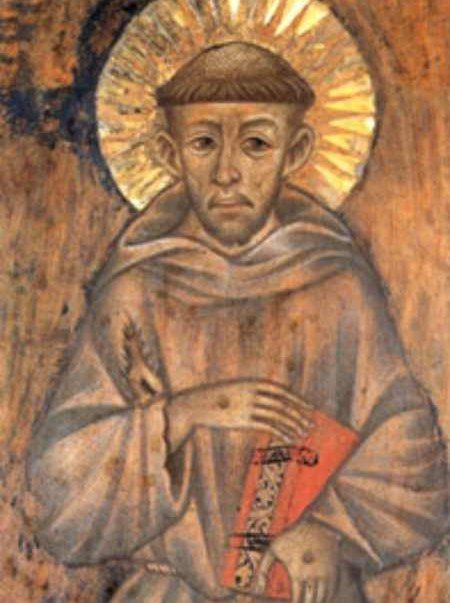
St. Francis of Assisi
The rich merchant's son who traded a life of silk and swords for poverty, peace, and a love of all creation — and founded an order that reshaped the Church.
On warm nights the young men of Assisi spilled through the streets with torches and singing, and at the head of them, more often than not, went Francesco Bernardone. The cloth merchant's son wore scarlet and fine French weave, kept his purse open to anyone who asked, and spent money the way other men spent breath. He meant to be a knight. He had the armor gilded and the horse decked out, and he rode toward the war in Apulia with the glory already rehearsed in his head.
He never reached it. A fever turned him back on the road, and in the night a voice came to him in his half-sleep and asked why he served the servant and not the Master. He came home to Assisi changed in a way he could not yet name. The old songs went thin in his mouth, and he took to riding alone in the valley below the town.
It was there he met the leper. The man stood in the road with his bell, his face half eaten away, and everything in Francesco recoiled; he had never been able to bear the sight or the smell of them. He began to turn the horse. Then, instead, he climbed down. He crossed the dust, pressed a coin into the ruined hand, and bent and kissed it. When he had ridden on a little way and looked back, the road lay empty. What had sickened him all his life had turned, on his lips, to something like sweetness.
In the crumbling chapel of San Damiano he knelt before an old painted crucifix, and in the dimness it seemed to speak: Francis, rebuild my house, which as you see is falling into ruin. He took it to mean the walls. He rode home, sold a bale of his father's best cloth and the horse besides, and carried the money back to the priest. Pietro Bernardone did not forgive it. He hauled his son before the bishop in the great square, the whole town gathering to watch, and demanded back his money and his senses. And there, in front of all of them, Francesco answered without a word — he stripped off his clothes, the scarlet and the linen, every thread, folded them with the last coins laid on top, and set the bundle at his father's feet. He stood naked in the cold square until the bishop rose and wrapped him in his own cloak.
Until now I have called you my father on earth. From this hour I can say only: Our Father, who art in heaven.
He went out past the gates in a beggar's tunic belted with a rope, and began to do with his own hands what he had heard in the chapel, hauling stones to mend San Damiano and then the other ruined churches of the plain. He slept in caves and church porches and begged his bread at the doors that had once welcomed him as a prince. Others came, and wore the same rough brown, and owned nothing, and went out two by two through the towns. On the road he would stop to preach to the birds, calling them his sisters, and the flock, they say, stayed to listen. Half blind near the end, his eyes ruined, he lay in a hut and composed a song to Brother Sun and Sister Moon, to Brother Wind and Sister Water, and to Sister Death herself.
The last wound came on the mountain of La Verna. After forty days of fasting the marks of the crucified Christ opened in his own hands and feet and side, and he carried them, hidden and bleeding, through the two years that were left to him. He died on an October evening in 1226, having asked the brothers to lay him on the bare earth and read aloud the Passion. As his voice failed in the last psalm, the larks — birds of the daylight, who never fly at dusk — rose over the roof of the hut and circled it, singing, in the falling dark.
1A Knight Turned Back
He was the son of Pietro Bernardone, a cloth merchant grown rich on the French trade, and he spent his father's money freely — on fine clothes, on long nights of feasting with the young noblemen of Assisi, who crowned him the king of their revels. When war broke out between Assisi and Perugia in 1202 he rode out armored for glory, and was captured, and spent the better part of a year in a Perugian prison, where he fell ill. Released and slow to mend, he set out again before long, this time for the wars in Apulia, dreaming of knighthood under a famous count. He got no farther than Spoleto. There, in the night, a voice asked him whether it was better to serve the lord or the servant; when Francesco answered the lord, it told him to go home, for he had read his dream backward. He turned back to the jeers of a town that had watched him ride off so splendidly, and the slow unmaking of the man he had been began.
2The Leper on the Road
All his life the sight had turned his stomach. In the Assisi of his boyhood the lepers lived apart in a colony on the plain, ringing a bell to warn travelers off, and when the wind carried the smell of them toward the city Francesco would press a sleeve to his face and ride the long way around. They were, to him, the edge of the world — the thing a young man with scarlet sleeves and a future did not touch.
Then came the afternoon in the valley when one stood in the road ahead of him, bell in hand. There was no long way around. Something in Francesco that he could not afterward explain made him rein in, dismount, and walk the few steps across the dust. He took the man's hand — the fingers wasted, the flesh gone wrong — and he put a coin in it, and he raised it to his lips and kissed it. Then he helped the man up, embraced him, and rode on. When he turned to look, the road was empty, and he never decided whether the figure had been a man or something else.
What he knew was that the dread had broken. In the weeks that followed he went down to the colony himself, carried alms to the lepers, washed them, and stayed. "What had seemed bitter to me," he said near the end of his life, "was turned into sweetness of soul and body." He dated the whole of his conversion from that one step off the horse.
3The Voice at San Damiano
He had taken to slipping into the half-ruined churches around Assisi to pray alone. In one of them — the little chapel of San Damiano, where a painted Byzantine crucifix hung over the altar — he heard a voice speak from the cross, three times: "Francis, go and repair my house, which you see is falling into ruin." He took it to mean the rotting chapel around him. Seized with zeal, he rode to his father's warehouse, loaded a horse with bolts of costly cloth, sold both cloth and horse at the market town of Foligno, and carried the money back to the frightened priest of San Damiano. When the priest refused to keep it, Francesco flung the purse onto a windowsill as if it were dust.
Then his father came hunting him in a rage, and Francesco hid — for a month, the accounts say, in a pit or a cave outside the walls, praying in fear and resolution. At last he came out, gaunt and filthy, and walked back into Assisi to face the storm. The crowds took him for a lunatic and pelted him with mud and stones through the streets.
4Before the Bishop
The lawsuit was his father's idea. Pietro Bernardone had indulged the boy's extravagance for years, but giving the family's money to a half-ruined chapel was theft, and he meant to have it back in front of the law. The hearing was moved to the bishop's court, and half of Assisi crowded into the square to see how the cloth merchant's strange son would answer.
The bishop spoke first, gently: if Francesco wished to serve God, he must return his father's money, for God did not want goods got by such means. Francesco agreed at once. Then he did more than anyone asked. He stepped behind a curtain, took off everything he wore — the fine tunic, the linen beneath it — and walked back out with the clothes folded in his arms and the last coins set on top. He laid the bundle at his father's feet and stood in the cold in front of the whole town, owning nothing.
Until now I have called you my father on earth. From this hour I can say only: Our Father, who art in heaven.
The bishop rose quickly, gathered the shivering young man into the folds of his own cloak, and held him there. Pietro picked up the clothes and the money and went home through the crowd. His son walked out the other way, into the hills, singing in French.
5The Gospel Without Gloss
For a while he lived as a wandering hermit, mending churches with his hands and nursing lepers, still unsure what God was asking. The answer came at Mass in the tiny chapel of the Portiuncula on the plain below Assisi, when the Gospel read aloud was Christ sending out the Twelve: take no gold, no purse, no second tunic, no sandals, no staff — go and proclaim the kingdom. Francesco listened as if hearing it for the first time. "This is what I want," he said, "this is what I long for with all my heart." He threw away his staff and his shoes, swapped his leather belt for a length of knotted rope, and went into the towns preaching penance and peace in plain words anyone could follow.
Men who had known him began to follow. Bernard of Quintavalle, one of the richest citizens of Assisi, sold all he had and gave it to the poor in the square. Peter Catani, a canon lawyer, came next, and then the plain, perpetually cheerful Giles. When there were a dozen of them, Francesco wrote a short rule stitched almost entirely from Gospel verses, and called his followers the Friars Minor — the lesser brothers, the least of all.
6The Pope's Dream
In 1209 he led his ragged dozen on foot to Rome, to ask Pope Innocent III — the most powerful pope of the Middle Ages — for leave to live exactly this way. The sight of a barefoot beggar requesting permission to keep the naked Gospel gave the pope pause; some of his court thought the plan unliveable, fit only for fools. Then, the tradition runs, Innocent dreamed that the Lateran basilica, the mother church of all Christendom, was leaning as though about to fall — and that a small, shabby, insignificant man had set his own shoulder beneath it and was holding it up. Waking, he saw that beggar's face again in front of him in Francesco. He blessed the brothers and gave them spoken approval to preach repentance, and they walked back north rejoicing, the order already beginning to multiply.
7Clare and the Poor Ladies
Among those his preaching set on fire was Clare, a beautiful young noblewoman of Assisi, not yet eighteen, who heard him preach in the cathedral one Lent and made up her mind to give her life to God as he had given his. On the night of Palm Sunday in 1212 she slipped out of her family's house by a side door kept for the dead and ran through the dark to the Portiuncula, where Francis and the brothers waited with torches. He cut off her long hair, clothed her in rough cloth, and gave her to Christ. Her relatives came to drag her home by force; she clung to the altar and bared her shorn head, and they gave up. Francis settled her at San Damiano — the very church he had rebuilt — and there she founded the Poor Ladies, the Poor Clares, who lived his poverty behind an enclosure wall. She outlived him by nearly thirty years and guarded his ideal of utter poverty against every attempt to soften it.
8The Sultan and the Fire
In 1219, while the armies of the Fifth Crusade besieged the Egyptian port of Damietta, Francis sailed to Egypt — not to fight but to convert the Sultan, or to die in the attempt. He crossed the open ground between the two camps, was seized and beaten by Muslim sentries, and kept demanding to be brought to their lord. Hauled at last before al-Malik al-Kamil, a nephew of the great Saladin, the little friar preached Christ to him for days on end. Tradition says he offered to walk through fire to prove the truth of his faith. The Sultan, charmed but unpersuaded, would not stake his own holy men on such a contest; yet he listened, treated his strange guest with courtesy, and sent him back through the lines unharmed, pressing on him gifts that Francis refused. He came home convinced that the road to the Muslim world ran not through the sword but through the witness of a peaceable life.
9The Crib at Greccio
At Christmas of 1223, in the hill town of Greccio, Francis did a thing no one had done before. He wanted the people to see with their own eyes the poverty into which God had chosen to be born, so he had a manger set up in a rocky hollow, with real hay, and a live ox and a donkey standing by, and there the Mass of the holy night was sung. As Francis, vested as a deacon, chanted the Gospel and then preached on the Child of Bethlehem, one of those kneeling there said he saw the saint lean over the manger and seem to wake a sleeping baby to life in his arms. From that night at Greccio the Christmas crib spread out through the whole Church.
10The Wolf of Gubbio
The Little Flowers of St. Francis tells how, in those years, the town of Gubbio lived in terror of a wolf so large and so fierce that it had taken not only livestock but men, and the people would not go beyond the walls without arms. Francis, staying nearby, said he would go out to the animal. The townsfolk begged him not to. He went anyway, with a few trembling companions who stopped well short.
The wolf rushed him with open jaws. Francis made the sign of the cross and called it to him — "Come here, Brother Wolf" — and the story says the beast shut its mouth and lay down at his feet like a lamb. He spoke to it as to a guilty man: it had done terrible evil, it deserved the gallows, and yet he wished to make peace. The wolf, hunger having driven it to kill, would be fed by the town for the rest of its days if it would harm no one again. Francis offered his hand; the wolf lifted its paw into it as a pledge. For two years, the tale ends, the wolf went door to door in Gubbio like an old dog and was fed, and when at last it died of old age the townspeople mourned it.
11The Canticle of the Creatures
By 1225 Francis was nearly blind, his eyes ulcerated and raw, and he lay sick in a hut of reeds beside San Damiano, where Clare and her sisters nursed him. He could not bear daylight; mice ran over him in the dark. And in the middle of that misery he overflowed, instead, with joy, and there he composed the Canticle of the Creatures — among the first poems written in the Italian tongue — praising God for Brother Sun and Sister Moon, for Brother Wind and Sister Water, for Brother Fire and for Sister Mother Earth who feeds and keeps us.
Hearing soon after that the bishop and the mayor of Assisi had fallen into a bitter, public feud, he added a new verse — praise to God for those who grant pardon for love of him — and sent two brothers to sing the whole Canticle before the pair of them. The mayor and the bishop wept, embraced, and were reconciled on the spot. Later still, when he was told the end was near, Francis added the final verse of all, welcoming "Sister Bodily Death, from whom no one living can escape."
12La Verna and the Stigmata
In the autumn of 1224 Francis withdrew to the mountain of La Verna, a gift of rock and forest in the Apennines, to keep a long fast before the feast of St. Michael. He was forty-two and already failing, half blind, worn thin by years of penance. He had asked God for two graces before he died: to feel in his own body something of the pain of the Passion, and in his heart something of the love that made Christ suffer it.
Near dawn on or about the fourteenth of September, praying on the bare rock, he saw what those who knew him later described as a seraph — a winged figure of fire, and within it the form of a man crucified. The vision pierced him with a joy and a grief he had no words for. When it faded, the marks were on him: in his hands and feet what looked like nails, dark and bent, of his own flesh, and in his side a wound that bled and stained his tunic. He hid them as well as he could for the rest of his life, drawing his sleeves down over his hands, letting only a few of the brothers tend them. He had asked to be made like the One he loved, and the mountain had given him the answer in his own body.
13Sister Death
Through his last two years he carried the wounds and a body he had punished so hard for so long that he now called it "Brother Ass" and begged its pardon for his old harshness. In the autumn of 1226, knowing the end had come, he asked to be carried down to the Portiuncula, where it had all begun. He had himself laid naked on the bare earth, blessed the brothers gathered around him, broke bread with them in memory of the Last Supper, and asked that the Passion according to John be read aloud. Then he welcomed Sister Death, exactly as the song he had written had promised, and died as the light failed on the evening of October 3, 1226. He was forty-four.
Two years later Pope Gregory IX, who had known him in life, declared him a saint, and above his tomb in Assisi there rose a great basilica of stone and frescoed gold — a mountain of beauty raised over the little poor man who had wanted to own nothing at all.
- c. 1181
Born in Assisi
Born Giovanni di Pietro di Bernardone, the son of a wealthy cloth merchant, and nicknamed Francesco.
- 1202
Captured in war
Taken prisoner during a battle between Assisi and Perugia, he spent nearly a year in captivity and fell gravely ill — the first crack in his old life.
- c. 1205
The voice at San Damiano
Praying before a crucifix in the ruined chapel of San Damiano, he heard Christ tell him, 'Rebuild my Church.'
- 1206
Renounces his inheritance
Before the bishop of Assisi he stripped off his fine clothes and gave them back to his father, choosing poverty for good.
- 1209
The Franciscan rule approved
Pope Innocent III gave verbal approval to Francis and his first brothers, the beginning of the Friars Minor.
- 1224
Receives the stigmata
While praying on Mount La Verna, Francis received the wounds of Christ in his own body.
- 1226
Death at the Portiuncula
He died singing, asking to be laid on the bare ground, welcoming 'Sister Death.'
- 1228
Canonized
Pope Gregory IX declared him a saint just two years after his death.
Francis met God by embracing the very thing he feared and letting go of everything he owned.
Reflection Questions
- 1
Francis got down off his horse and kissed the hand of the leper he had always dreaded. What do you think changed in him in that moment?
- 2
Who or what are the 'lepers' in your own life — the people or situations you tend to cross the road to avoid?
- 3
What is one concrete way you could move toward someone this week instead of away from them?
Prayer
Lord, make me an instrument of your peace. Where there is hatred, let me sow love; where there is injury, pardon; where there is doubt, faith; where there is despair, hope.