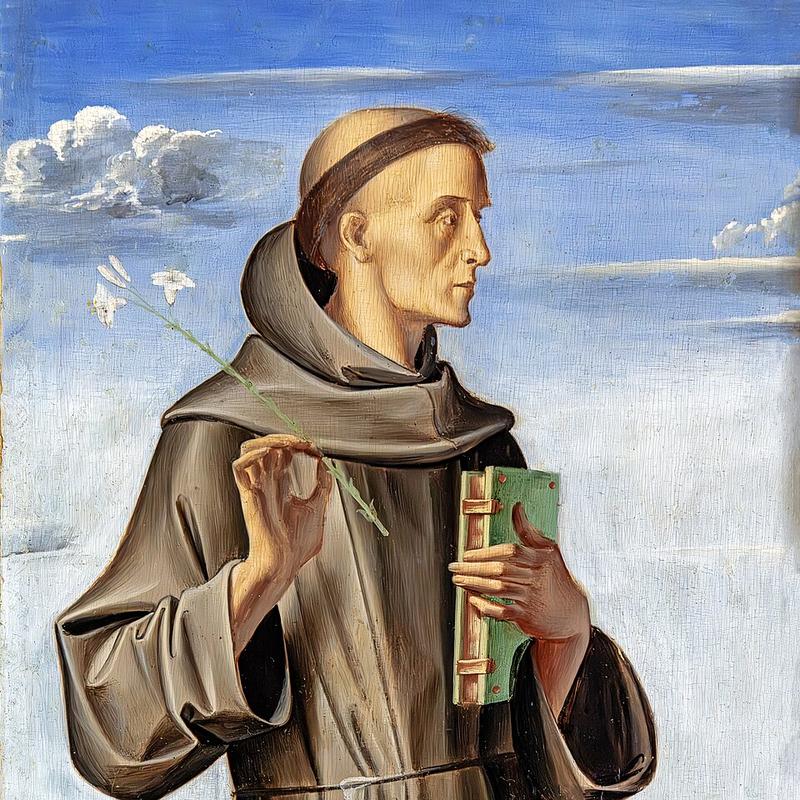
St. Anthony of Padua
A gifted Portuguese scholar who hid his learning by washing dishes in a Franciscan hermitage — until one surprise sermon gave him away, and he spent the last nine years of his short life as the most powerful preacher in Europe.
The room had gone quiet, and nobody would stand up. It was 1222, an ordination dinner at , Dominicans and Franciscans seated together — and through some mix-up, no one had been asked to preach. The superior turned to the Dominicans first; they were the order built on preaching, and one by one they begged off, unprepared. Down the table the silence stretched. At last his eye landed on a quiet Portuguese who washed the dishes at a mountain and had never shown a sign of being anyone at all, and he ordered him, under obedience, to say whatever the Holy Spirit gave him. The began slowly, almost stumbling. Then something he had buried for years came up through the plain words — he knew the Scriptures so completely it was as if he carried the whole book behind his eyes — and the whole room hung on his voice. The priests sat staring at their dishwasher. His name was Anthony, and after that night nothing about him stayed hidden.
He had been born in Lisbon around 1195 and baptized Fernando, the son of a noble family with a house in the shadow of the cathedral. At about fifteen he gave himself to the of St. Augustine. When old friends from the city kept turning up to talk away his quiet, he asked to be sent further off, to the order’s great house of Santa Cruz at , and there for nine years he did little but pray and read until the Scriptures soaked all the way into him. He might have died a learned canon, unknown. Then the dead came home. In 1220 five Franciscan friars — the first martyrs of the new order, men Fernando may have met as they passed through — were beheaded in Morocco for preaching Christ, and their remains were carried through the city in slow procession. Fernando watched them pass, and something in him gave way. The next time Franciscan brothers came begging at the canons’ door he told them everything: take me, and send me where those men died. He traded his habit for their rough grey one, took the name Anthony from his new ’s patron, and sailed for Morocco to be killed for Christ.
That death was not his to have. Fever flattened him the moment he landed, and held him down the whole winter, useless in a strange country while the martyrdom stayed out of reach. By spring he gave up and took ship for home — and the sea overruled him too. A storm seized the vessel and flung it the wrong way across the Mediterranean, to Sicily, about as far from Lisbon as the water could carry him. From there he made his way north to Assisi, where in 1221 thousands of friars were gathering around Francis himself for the great . In all that crowd, nobody wanted the sick foreign brother. A provincial took him at last out of plain charity and packed him off to Montepaolo, a in the hills of Romagna, where he said Mass for the others, swept the floors, scrubbed the pots, and kept his mouth shut about what was in his head. broke the silence.
After they never let him rest. He walked northern Italy and southern France, through districts the had hollowed out, and crowds that had jeered at other preachers packed the churches, then the town squares, then any field wide enough to hold them. They called him the hammer of heretics. But it was rarely the hammer that broke men open — it was the plainness, and the mercy. Francis, who feared that book-learning could quietly snuff out a ’s prayer, sent him a short letter that became the order’s whole rule for study: he called Anthony “my bishop” and blessed him to teach theology to the brothers. So the dishwasher became the Franciscans’ first teacher, at , and bent the same mind to writing the cycles of sermons that, seven centuries on, would make him a Doctor of the Church.
His last and greatest work was . Through the Lent of 1231 he preached every single day, and the city all but stopped to listen: shutters down, shops closed, crowds reckoned at thirty thousand keeping their places since the night before, the sermons spilling out of the churches into the open meadows because no roof could cover them. When the preaching ended he sat in the confessional until the daylight gave out. He kept none of the fame for himself. He turned it on the men locked in ’s debtors’ prison — and that March, at his urging, the city made it law: a man who gave up all he owned could no longer be jailed for the rest of his debt. By summer he was finished: swollen with illness, worn through, not yet forty. They had built him a little cell up in the branches of a walnut tree at , and from there, feeling the end, he asked to be carried home to his city. He got as far as , on its very edge. He sang a hymn to Our Lady, and then his eyes fixed on something the brothers around the bed could not see.
I see my Lord.
He died on June 13, 1231, and they say the children of were running through the streets crying that the saint was dead before any bell had rung. Within the year — the fastest the Church had ever moved — Gregory IX declared him a saint. Three decades on, when they shifted his body to a finer tomb, the friars opened the coffin and found it gone to dust, all but one thing: the tongue lay there whole and undecayed, the one tool he had spent down to nothing.