St. Germaine Cousin
A sickly shepherd girl despised by her own household, who slept under the stairs, prayed in the fields, and shared her scraps with beggars — and whom heaven, and eventually all of France, refused to overlook.
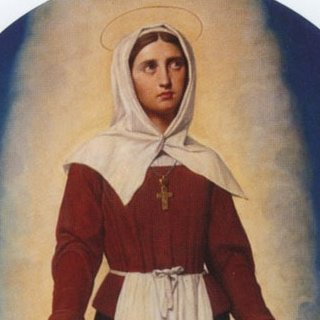
The girl slept under the stairs. In the farmhouse at , in the rolling country west of , the family ate at the table and slept in beds, and Germaine — the daughter of the house — was given a pallet in the cupboard beneath the staircase, or a corner of the barn on a heap of vine cuttings, with scraps for supper. She had been born in 1579 with a withered right hand, and the swellings of stood out on her neck; her mother had died while she was still an infant, and the woman her father married next could not bear the sight of her. The stepmother kept her from the other children as though her sickness might spread, worked her, starved her, and, the accounts say, was not sparing with blows and scalding water. Her father, Laurent Cousin, a farm worker of some standing in the village, let it happen. As soon as she was old enough, they sent her out of the house altogether, into the fields with the sheep.
Out in the fields she was alone all day with the flock at the edge of the . The girl who had been taught almost nothing — she could manage little beyond the Our Father and the Hail Mary — talked to God as though he were standing in the grass beside her, told the beads of her rosary, and arranged her whole day around the one appointment she would not miss. When the church bell of rang for daily Mass, Germaine planted her upright in the ground, told her guardian angel to mind the sheep, and went. The village shook its head: the Bouconne was wolf country, and an untended flock was an eaten flock. The wolves never took one. Year after year, the people of noticed, the sick girl’s sheep grazed unharmed around a spindle stuck in the dirt while she knelt at the back of the church.
They noticed more. On the path between the fields and the village she gathered the children no one was teaching and taught them, in her plain words, what she knew of God. Out of her own scraps of bread she fed beggars — she who was fed on leftovers herself. They told of the day the stream called the Courbet ran high with winter rain and the villagers watched the little shepherdess walk to the edge of the roaring water to get to Mass; the waters, they said, drew apart and let her cross dry, going and coming. And they told, above all, of the bread. One winter morning the stepmother came shouting after her, accusing her of stealing bread away in her apron, her hand raised to strike, neighbors gathering. Germaine opened the apron. Flowers fell out — fresh ones, of kinds no winter in could grow — and she is said to have handed one to her stepmother. Tradition tells it, and never stopped telling it.
Over the years the village changed its mind about her. The scorn — for her sores, her hand, her rags — wore slowly into something like awe, and the people began to call her the little saint. Even her father woke at last. He forbade his wife to mistreat her and offered Germaine, finally, her place in the house and a proper bed. She thanked him and asked to keep her nook under the stairs.
She did not have long to enjoy the peace. One morning in the summer of 1601, when she had not come out for the sheep, her father went to the cupboard under the stairs and found her dead on the pallet, her rosary in reach. She was twenty-two. They say two travelers passing the farm in the night had seen lights and a passage of radiant figures toward the house; the village buried her in the church of , opposite the pulpit, in a place of honor the household had never given her.
Forty-three years later a gravedigger, digging in the church floor for another burial, uncovered a young woman’s body fresh as the day of death, the right hand withered, the marks on the neck — the village elders recognized their little saint at once. The body was set in a lead casket near the pulpit and the miracles began to be counted. In the Revolution, men hauled the casket out and buried it in ; the body endured even that. In 1867 Pope Pius IX canonized her, and the despised girl from under the stairs was honored as a saint by the whole Church — patroness now of the abused, the disabled, and the abandoned, of everyone the household forgot. In the bell still rings over the fields where a once stood upright in the grass, holding her place among the sheep.