St. Anthony of Padua
A gifted Portuguese scholar who hid his learning by washing dishes in a Franciscan hermitage — until one surprise sermon gave him away, and he spent the last nine years of his short life as the most powerful preacher in Europe.
The Life of St. Anthony of Padua in Chapters
1The Coffins from Morocco
In the winter of 1220 saw a procession like nothing before it: the bodies of five Franciscan friars — Berard and his companions — carried home from Morocco, where they had preached Christ in the streets and the mosque doorways until the sultan’s patience ran out and the swords came down. They were the first martyrs of Francis’s young brotherhood. Don Pedro of Portugal had paid to ransom their remains and bring them back, and they were laid in the church of Santa Cruz — the very house where the canon Fernando lived among his books.
He was about twenty-five then, nine years a religious, with a safe and learned life laid out in front of him. The coffins undid all of it. Here were men of no great schooling who had handed Christ the one thing Fernando had not yet dared to offer — everything, all at once, with nothing kept back. So when brothers from the little of Santo Antão dos Olivais came begging at the priory, he opened his heart to them: he would wear their habit on a single condition — that they send him to the Saracens. His own community did not take it kindly. One canon, the story goes, saw him off with a sneer — “Go, then; perhaps you will become a saint.” The permission came anyway. He put on the grey habit, took a new name from the ’s patron, the great hermit of Egypt, and within months stood on the deck of a ship bound for Morocco and the death he was chasing.
2Blown to Sicily
The mission collapsed completely — which is exactly how everything else became possible. Anthony had barely landed before a sickness took him and would not let go, pinning him down the entire winter so that both the preaching and the martyrdom slid out of reach while he lay useless in a foreign land. By spring he read the message in it and took ship for home. Then the weather had its say. A storm caught the vessel and drove it east, clear across the Mediterranean, until it fetched up on the coast of Sicily.
The Franciscans of Messina took the castaway in, and from them he learned the whole order was about to gather at Assisi — the great Pentecost meeting of 1221, the , thousands of friars camped in huts of branches around the Portiuncula while Francis, too ill by then to govern, sat at his deputy’s feet and now and then tugged the man’s habit to whisper what should be said. Anthony went, and there he learned what it is to be nobody. When the meeting broke up and the provincials gathered their men, no one called his name. He was foreign, sickly, silent about everything that mattered. In the end he had to ask — Brother Gratian, the friars’ leader for Romagna, to take him on and teach him the Franciscan life. Gratian, with nothing better to do with him, sent him up to the mountain of Montepaolo, about as close to nowhere as the order owned.
3Montepaolo
The brothers at Montepaolo kept a poverty so bare it startled even Franciscans. Anthony was a priest, so he said their Mass; for the rest he asked for the lowest work in the house and got it — the kitchen, the dishes, the broom. One of the friars had hollowed a cell out of a cave in the hillside, and Anthony begged the use of it, climbing up each day with a little bread and water to pray, and coming back down so emptied he could sometimes barely walk to the table.
What none of them knew was what he was carrying. Nine years at Santa Cruz in — one of the great schools of the Spanish church — had set the Scriptures in him almost word for word, with the Church Fathers and the learning of the age ranged around them in a memory people would later describe with something like awe. He said not a word about any of it. No one had ordered the silence; it was his own choice, the same instinct that had asked for the dishes. To the brothers he was a devout, slightly frail man, useful for Masses and pots. They went on thinking so for the better part of a year — until the afternoon at when obedience, the one key that fit the lock, turned and opened the whole storehouse at once.
4The Sermon at Forlì
It was an ordination at , in 1222, Anthony himself most likely among those being ordained — Dominicans and Franciscans together, and a custom that wanted a sermon, and through some slip nobody lined up to give one. The superior asked the Dominicans, the preaching order; each man begged off, with nothing prepared. The Franciscans, the same. As the silence curdled into embarrassment, his glance fell on the quiet Portuguese brother, and — half in desperation, the sources hint — he put him under obedience to preach whatever God should give him.
Anthony tried to duck it. He was better, he said, at washing dishes. The order stood. So he began, plainly, and the room tilted under them. The learning came first — Scripture answering Scripture, the Fathers each in their place, a mind moving through the Bible the way a man walks his own house in the dark — and then the fire underneath the learning caught. The men who had pitied him sat stunned. Within days the report was on every road, and the provincial hauled him out of the kitchen and handed him the work that would kill him: preaching. The order had been hiding the greatest preacher alive behind a stack of dirty plates, and never knew.
5The Hammer of Heretics
The Italy and southern France Anthony now crossed on foot were mission country in all but name. The Cathar and kindred heresies had sunk roots into the towns — preachers of a bloodless, body-hating religion whose followers often out-fasted the very Catholic clergy they despised — and they had carried whole districts, because so much of the local church had earned the contempt. Anthony’s answer was not, in the main, attack. He preached Scripture, plainly and overwhelmingly, in Rimini and the towns of Lombardy, then in Montpellier, Toulouse, and the hill country of Languedoc, and he came down as hard on Catholic greed and sloth as on any heretic’s doctrine. The crowds outgrew the churches. Later ages would name him the hammer of heretics, but the records keep more conversions than defeats — men came to argue, lost, and stayed.
To these years tradition fastens the most famous of his wonders. At Rimini, they say, when the heretics shut their ears to him, he walked down to the shore where the river runs into the sea and preached to the fish instead — and the fish rose in ranks at the water’s edge, heads lifted clear of the waves, holding still until he blessed them, while the townsfolk came running to gape. They tell, too, of a starving mule that knelt before the Blessed Sacrament in Anthony’s hands rather than touch the oats its master held out, and of the scoffer won over on the spot. The legends only put into pictures what the sober record counts in numbers: when Anthony preached, even creation seemed to lean in.
6A Letter from Francis
Inside the order, Anthony’s learning posed a delicate problem. Francis mistrusted book-learning down to the bone — he had watched study sour into pride, and feared professors more than persecutors — and yet his friars, sent out to argue heretics back into the faith, plainly needed theology. So the brothers asked Anthony to teach. And Anthony, true to himself, would not climb into the chair without the founder’s blessing. It came in a short letter the order has guarded ever since, written with surprising tenderness:
To Brother Anthony, my bishop: I am pleased that you teach sacred theology to the brothers, provided that, as is contained in the Rule, you do not extinguish the spirit of prayer and devotion with study of this kind.
In that one sentence Francis settled, for his order and in a way for the whole Church, the long quarrel between the library and the chapel: study was blessed, so long as prayer stayed lit. Anthony began teaching the friars at — their first teacher of theology — and later, tradition adds, at Montpellier and Toulouse. Out of the same labor came his written sermons, the great cycles for Sundays and feast days, dense and bright with image, built to arm other preachers. It was on the strength of those pages, seven centuries later, that Pius XII named him a Doctor of the Church — the Doctor Evangelicus, the Evangelical Doctor — in 1946.
7The Lent of Padua
was the city of his heart, and the Lent of 1231 was the summit of his life. Free of office now, and failing, he set himself to preach every single day of the fast — a thing almost no one had attempted — and the city simply surrendered to him. People came in the night to hold their places. The churches overflowed, so the sermons moved to the squares, then out to the open meadows; the crowds were counted at thirty thousand, whole villages pouring in, shopkeepers shuttering their stalls to go. Old enemies made peace in the open. Money-lenders gave back what they had squeezed. And when each sermon was done, Anthony folded himself into the confessional, hour after hour, sometimes until full dark — a swollen, sick man in his thirties spending the last of himself one penitent at a time.
The preaching had edges, and felt them. He went after money-lending by name, and after the law that let a creditor keep a ruined debtor in prison without end. On the seventeenth of March, 1231, with the Lenten sermons still running, the city passed the statute he had pressed for: a man who gave up his goods was no longer to be jailed for his debts. They wrote it into the books, where it stands among the oldest monuments of a preacher turning a crowd into justice. He is the patron of the poor to this day, and the bread still handed out in his name keeps the memory of that Lent.
8The Walnut Tree
When Easter had wrung the last of his strength out of him, Anthony withdrew with two companions to , north of , as the guest of Count Tiso, a nobleman devoted to the friars. The friary itself proved too busy for a dying man’s prayer, so he asked for something stranger and simpler. A great walnut tree stood near the ; at his word the brothers built him a small cell of branches and woven mats up in it, and there he passed his days in prayer, climbing down only for meals — the most famous preacher in Europe roosting in a tree like one of the birds his father Francis used to preach to.
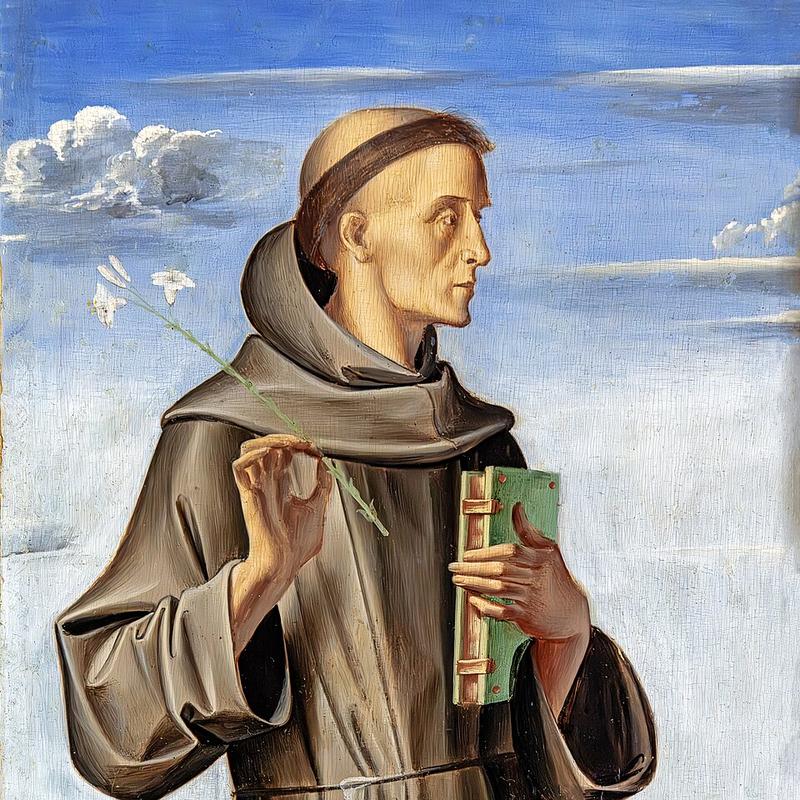
To these last weeks tradition gives the tenderest of all his stories. One night, they say, Count Tiso came to the door of Anthony’s room and saw light pouring out beneath it; he looked in and found the with a child in his arms — the Child, shining, cupping the worn face that held him — and Anthony, knowing he had been seen, begged the count to tell no one while he lived. History cannot get inside that room, and does not need to: the picture of Anthony with the Christ Child on his arm became the way the whole world remembers him — the spent scholar, at the very end, holding the Word he had given his life to preaching. Then, on the thirteenth of June, struck suddenly worse at the midday meal, he understood what was coming, and asked to be carried to , to die in his own city.
9The Saint Is Dead
The cart never reached the walls. The jolting road took what little he had left, and the brothers turned aside at , just outside , where the Poor Clares kept a convent and the friars a hospice. They laid him down. He made his confession and was absolved, and then, in a voice the brothers could still make out, he began the hymn to the Virgin, O gloriosa Domina. When the singing stopped he lay quiet, his eyes turned up and shining, and a brother bent close to ask what he saw. “I see my Lord,” he said. He received the last sacraments, and within the hour, on the evening of June 13, 1231, he was gone — about thirty-five years old, eleven of them a Franciscan.
took the news anything but quietly. They say the children were already running and weeping through the streets that the saint was dead before any announcement reached them; whole neighborhoods took up arms over which of them would keep the body, until it was settled where he had wanted — the little church of Santa Maria Mater Domini, over which the basilica Paduans still call simply il Santo would one day rise. The miracles started at once and did not stop. Gregory IX, who had known him and heard him preach, declared him a saint at Spoleto on May 30, 1232, less than a year after his death — among the swiftest such judgments ever made. And in 1263, when the relics were moved into the new basilica, the friars opened the coffin before their minister general, Bonaventure: the body had fallen to dust, but the tongue lay there whole and fresh. Bonaventure lifted it up and kissed it — the tongue that had never once stopped giving away what it knew.