St. Boniface
An English monk who walked away from a quiet life of books to spend forty years preaching in the German forests — felling a god's oak with an axe, building a church across half a continent, and dying with a book raised over his head.
The crowd had gathered to watch a god kill a man. The great oak at belonged to Thor, the thunder-god, and for as long as anyone could remember no one had dared lay a hand on it. Now a foreign bishop stood at its roots with an axe, and the watchers waited, half in terror and half in hope, for the sky to open and strike him dead. He could have preached at the tree from a safe distance. Instead he swung. The chips flew, the trunk groaned, and a wind — they said afterward — caught the high branches and helped it over; the huge tree crashed down and split apart. No bolt came. No thunder. The man set down his axe and told them to cut the timber into beams for a church.
That was the kind of man he was, and had always been: the one who chose the harder road on purpose. He had been born far from these forests, in the green west of England, in the kingdom of , and his name then was Wynfrith — friend of peace. By thirty he had everything a churchman in England was meant to want. He was a priest, he ran the abbey school, he had written the first Latin grammar any Englishman ever made, and a calm, honored life lay open in front of him. He could have spent it among his books. He left instead for the mission fields east of the , where the work could get a man killed.
His first attempt failed completely. In 716 he sailed for and found the country at war, its churches in ruins, and came home with nothing. Then the easy door swung open: his old died, the monks elected Wynfrith to lead them, and the quiet life he had walked away from was handed back to him. He turned it down. He went to Rome instead, knelt before Pope , and asked for the hardest work the Church could give him — the pagans east of the . The pope took his measure, gave him the work, and gave him a new name: Boniface. He never saw England again.
For the next thirty years he walked deeper into the forests of Europe and built a church where there had been none. He felled the oak. He waded into cold rivers to baptize whole villages. He raised churches and convents across and , and when his own hands ran short he wrote letter after letter home, begging England for monks and nuns and books — once asking an to copy the letters of in gold ink, so the Scriptures would shine before pagans who trusted nothing they could not see. He marked the boundaries of that still exist, and founded, deep in the woods, the great abbey of . None of it was safe. He went unarmed among people who had killed missionaries before him, and kept going.
The honors came, and he never softened under them. He forced a slack, half-pagan clergy back into order through council after council, until the church north of the Alps was tied fast to Rome. One pope after another leaned on him; they made him archbishop, then of all Germany, then archbishop of , the most powerful churchman in the world. He wrote to a friend, in those years, that the Church was a ship in a storm and her shepherds had no business jumping off.
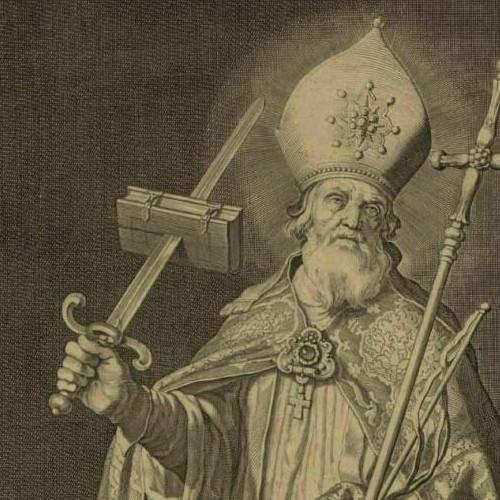
He was nearly eighty when he proved he meant it. He could have died in the comfort of , honored and safe. Instead he gave up his office, gathered a band of companions, and went back to — to the marsh country that had beaten him as a young man. This time the work went well. He baptized thousands and called the new converts to a riverside meadow near to be confirmed. On the morning he sat waiting for them, an armed band came across the fields instead. His companions reached for their swords; he stopped them, telling them not to return evil for evil. Tradition holds that as the blades came down he raised a book over his head, to take the blow on its pages. They killed him and all fifty-two with him, then tore open the baggage for gold and found only books and , which they flung into the reeds. Some were fished out later. One, kept at to this day, is slashed clean through and dark with old stains — a book holding a of , titled On the Advantage of Death.