St. Germaine Cousin
A sickly shepherd girl despised by her own household, who slept under the stairs, prayed in the fields, and shared her scraps with beggars — and whom heaven, and eventually all of France, refused to overlook.
The Life of St. Germaine Cousin in Chapters
1The Cupboard Under the Stairs
Germaine’s misfortunes arrived all together, at the beginning. The withered right hand was from birth; the — sores that swelled and broke on her neck — came early and never left; her mother, Marie Laroche, died while Germaine was still in the cradle. When Laurent Cousin remarried, the new wife, Hortense, looked at the sick, scarred child and decided she was a danger and a disgrace to her own children. The separation was total: Germaine ate apart, on scraps; slept apart, in the barn on vine twigs or in the cubbyhole under the farmhouse stairs; was kept from the other children as though her disease could leap to them across a room.
The accounts gathered for her canonization did not soften the rest: blows, scalding water flung at her legs, days of labor a healthy child would have strained under. Hardest of all, perhaps, was the father’s silence — Laurent was no pauper and no fool, and he let it all be done in his own house for years. The village saw and largely shrugged; sickly children with hard stepmothers were no novelty in the of the 1580s, a country worn raw by the wars of religion. No one taught her to read. No one expected anything of her at all, and whatever she became she became out in the fields, alone with the sheep and the few prayers she had taught herself.
2The Distaff in the Grass
A shepherdess spun while she watched — wool on the , thread on the spindle, the day’s labor twice over. When the bell of rang for Mass she drove the upright into the turf at the edge of the pasture, spoke to her guardian angel as one speaks to a trusted neighbor, asked him to keep the flock, and walked to the village church. She did it daily, in all weathers, for years. Sheep in that country grazed within reach of the Bouconne forest, and the Bouconne had wolves; an untended flock by the treeline was a standing invitation. The flock was never touched. Not a lamb, the villagers swore later, in all the years she kept it — while flocks with their shepherds present lost animals season by season.
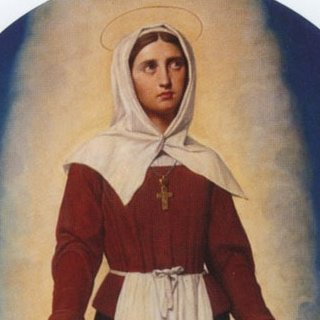
At Mass she knelt at the back, ragged, the village children smirking at her neck. She received Holy Communion so prayerfully that the parish priest came to watch her, and went back to the fields. Her theology was the rosary, the two prayers she knew, and a habit of speaking with God so constant that she was rarely lonely. The fields gave her what the farmhouse refused: room, quiet, and long hours alone with God. ’s painters and statue-makers would picture her that way ever after — the girl, the sheep, and the standing upright in the grass.
3The Waters of the Courbet
Between Germaine’s pasture and the village ran a stream the people called the Courbet — a trickle most of the year, a brown torrent after winter rains. The road to daily Mass crossed it. On days when grown men reckoned the ford impassable, the villagers saw the shepherd girl come down to the edge of the flood and go over, and arrive at church dry; and the story they told ever after was that the waters parted for her — drew back like a curtain at her approach and let her walk the streambed, going and coming home again.
Tradition holds it, and swore by it for generations; it entered the testimony gathered when the Church later examined her life. Whatever the crossing looked like to the people who watched, the plain fact behind it was that nothing — not flood, not cold, not the work waiting at home — kept Germaine from Mass. The village that had once laughed at her was beginning, slowly, to stop.
4Flowers in Winter
The most famous moment of her life lasted perhaps ten seconds. It was deep winter, and Germaine was leaving the farmhouse with her apron gathered up, carrying — the stepmother was certain — bread stolen from the kitchen to waste on beggars. Hortense came after her in a fury, stick in hand by some tellings, shouting theft loudly enough to bring the neighbors, and Laurent for once was present and made his daughter answer. Germaine, accused, opened her apron. Out fell flowers — fresh, bright, springtime flowers of a kind the frozen country could not have produced, tumbling over the winter ground in front of all of them. They say she took one and offered it to her stepmother.
It is the story told first and loved best, and the one nearly every picture of her shows. What the tellers never doubted was the part that needed no miracle: the girl really had been carrying her own bread to the beggars, day after day, and the whole parish knew it. After the flowers, no one in the house accused her of theft again.
5The Place She Would Not Leave
By her last years the tide in had fully turned. The children she gathered on the paths to teach about God ran to her now; the poor blessed her; the parish had quietly renamed her the little saint, only half in jest and then not in jest at all. The shame of the household finally cracked under the weight of the village’s reverence. Laurent Cousin forbade his wife to lay a hand on Germaine again and offered his daughter everything that had been withheld — the family table, a room, a bed, the ordinary daughterhood she had never had.
She declined the bed. Gratefully, by every account, and without a word of reproach — but she asked to stay in the cupboard under the stairs, on the pallet, as before. The cupboard and the straw had been hers for twenty years, and she wanted nothing better now. So her last years were spent in the same place as all the hard ones — the same stairs, the same pallet, the same walk to the sheep at dawn — except that now the house left her in peace, and stepped around her almost shyly. She died in that nook, alone, on a June night in 1601, twenty-two years old; her father found her in the morning. Two travelers on the road that night, the story is told, saw a brightness pass toward the farmhouse, and maidens robed in white, one of them crowned with flowers, returning the way they came.
6The Opened Grave
They buried her in the village church, opposite the pulpit — an honored spot for a girl the parish had come to revere. The people who had known her grew old and died, and in time she was seldom spoken of. Then, in 1644, a gravedigger preparing the floor for a relative’s burial struck her coffin and opened it, and called for the others to come and look. The body was incorrupt — soft and whole after forty-three years in the earth — and the oldest villagers identified her on the spot by the marks no one had forgotten: the withered right hand, the scars of on the neck. The little saint was moved into a lead casket and set near the pulpit, and the cures and graces reported at her tomb began to be written down in earnest.
In 1793, during the Revolution’s war on the shrines, men dragged the casket from the church and buried it in a pit with and water to dissolve it; recovered two years later, it was found still mostly whole, and the people of put their saint back. The cause went to Rome with sixty years of reported miracles behind it, and on June 29, 1867, Pius IX canonized Germaine Cousin. The churches of her devotion now name her patroness of the abused, the disabled, the unwanted, and the poor — and in , where a basilica stands for her now, pilgrims still pass the fields where a girl once set her upright in the grass and left her sheep to walk to the bell.