St. Joan of Arc
An unlettered peasant girl who heard voices in her father's garden, led France's armies to break the siege of Orléans, saw a king crowned — and was burned as a heretic at nineteen by the Church that would one day make her a saint.
It came to her at noon, in her father's garden, with the church bells still ringing over the village. A light on her right hand, toward the church, and out of the light a voice. She was about thirteen, the daughter of a farmer in Domrémy, a place on the frontier where the war washed back and forth and the people slept with one eye on the road. She could not read a word. The voice told her to be good and to go often to church, and she wept, because it was beautiful and she wanted it to stay. It came again, and again, and over the next years it grew specific past all bearing: she was to leave home, find a captain at Vaucouleurs, cross a hundred miles of enemy country, lift the siege of Orléans, and see the disinherited heir of France crowned at Reims. "I am a poor girl," she told the voices; "I do not know how to ride or fight." They answered that it was God who commanded it.
She went. At Vaucouleurs the captain, Robert de Baudricourt, laughed and told her cousin to box her ears and send her home to her father. She came back, and came back again, and would not go away, and when she announced from the town that the French had been beaten that very day in a battle outside Orléans — news that arrived, true, days later — the laughter stopped. They cut her hair to the ear, dressed her as a man for the road, gave her a horse and six men, and she rode out in the dead of winter through country thick with the enemy, sleeping in her clothes, eleven days, to Chinon.
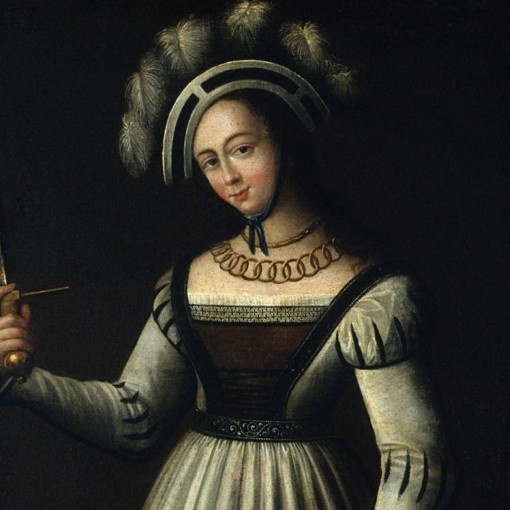
The court tried to trick her. The Dauphin hid himself in the crowd of his courtiers and set another man in his place, and she walked past the decoy, crossed the hall, and knelt at the feet of the right man, whom she had never seen. What she told him in private no one ever learned; he came out of it pale and believing. The churchmen at Poitiers examined her for three weeks for witchcraft and for fraud and found neither. They gave her white armour, a standard painted with the King of Heaven, and a sword, and sent her north with the relief army to Orléans, where the city had been starving behind its walls for half a year.
She was seventeen. Within a week the English forts around Orléans had fallen one by one to assaults she drove forward through the dusk; on the seventh day an arrow went through her shoulder above the breast, and she wept with the pain, and then pulled it out herself and went back to the fighting until the great fort of the Tourelles was taken and the siege broke. France had not won a battle like it in a generation. They began to call her the Maid of Orléans. She wanted to press the victory at once, because the voices had already told her she had little time — a year, and not much more. At Patay her army caught the English in the open and destroyed them. Then she dragged the cautious, frightened court the long road to Reims, took the towns that closed their gates, and on a July Sunday stood with her banner beside Charles as the holy oil was poured and he became, at last, the King of France. Someone asked why her standard was carried into the sanctuary. Because it had shared the toil, she said; it was right that it should share the honour.
After that, everything turned. The king made truces; her assault on Paris failed and an arrow took her in the thigh; the favourites at court whispered that she had grown too large. In the spring she rode to defend Compiègne against the Burgundians, and outside its walls she was pulled backward off her horse and the gates were shut, and she was taken. Charles, who owed her his crown, did nothing. Her captors sold her to the English, who wanted her dead and discredited, and handed her to a church court at Rouen under a bishop who served their cause.
For months they questioned her — peasant girl against a roomful of doctors of theology — and again and again she slipped their traps with a plain shrewdness that unnerved them. Asked whether she knew she was in God's grace, a question built to damn her whichever way she answered, she said:
If I am not in God's grace, may God put me there; and if I am, may God keep me there.
They condemned her in the end for wearing a man's clothes and for trusting the voices she would not deny. On the thirtieth of May, 1431, they led her into the Old Market Place of Rouen, chained her to a high stake above the crowd, and lit the fire. She asked for a cross. A soldier bound two sticks and gave it to her, and a priest brought one from the church and held it up where she could see it, and she called on the name of Jesus over and over until the smoke took her voice. She was about nineteen. When it was finished the executioner raked the ashes into the Seine, so that nothing of her would be left for anyone to keep.