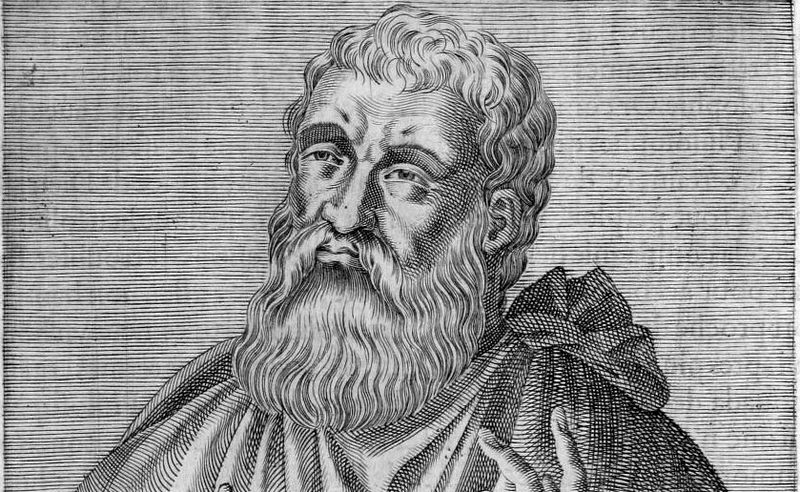
St. Justin Martyr
A restless philosopher who tried every school of Greek thought hunting for God — until a stranger on the shore pointed him past reason to Christ, the 'true philosophy' he would defend before emperors and die for in Rome.
He had worn out four teachers and was hunting a fifth. Justin walked a lonely stretch of shore in the rough cloak of a professional philosopher, turning over the Platonist promise that a soul made pure enough might one day look on God with the mind's own eye. An old man was suddenly walking beside him — grave, unhurried, a stranger — and instead of admiring the young man's learning he began quietly to take it apart. If Justin had never seen God nor heard him, how did he imagine the mind could reach him unaided? The philosophers were sure the soul could climb to that vision on its own strength; the old man was not. There were men, he said, older than any of the philosophers, who had not reasoned their way to God but had been filled with his Spirit and had simply told what they saw — the prophets, whose words were even now coming true. Then the stranger went his way and was gone, and Justin never learned his name.
Straightway a flame was kindled in my soul, and a love of the prophets and of those who are friends of Christ possessed me.
He had been born around the year 100 in Flavia Neapolis, the old Shechem in Samaria, to Greek parents who kept the pagan gods and gave their clever son the best education money could buy — poetry, rhetoric, history, and then philosophy, which he loved above the rest because it promised the one thing he wanted, which was God. He went from school to school like a man trying doors. The Stoic taught him nothing about God and seemed to think the question hardly mattered. The Peripatetic, after a few days, wanted to settle his fee, and Justin decided that a man so anxious about money was no philosopher at all. The Pythagorean would not begin until his pupil had first mastered music, astronomy, and geometry, and Justin had no patience for the delay. The Platonist delighted him; the flight of the mind toward the bodiless and the eternal thrilled him, and he believed he was nearly there. Then came the old man on the shore, and the closed door of Plato opened onto something the philosophers had never owned.
What the argument began, the martyrs finished. Justin had heard the ugly things people said about the Christians — that they were godless, that they feasted on horrors in the dark — and he had also watched them die, unafraid, rather than deny a name. A man living in evil and in love with pleasure, he reasoned, does not walk calmly to the sword. He was baptized, most likely at Ephesus, somewhere around the year 130, and then he did a thing no convert had quite done before: he kept the cloak. The philosopher's pallium stayed on his shoulders, the uniform of a man who had found wisdom — because he was certain now that he had found it at last, that Christianity was not the enemy of philosophy but its completion, the true philosophy toward which all the rest had only been groping.
So he turned teacher. At Ephesus he fell into a two-day debate with a learned and courteous Jew named Trypho, and argued from the prophets that the crucified Galilean was the very Christ those Scriptures had foretold; he wrote the whole conversation down. He traveled, and at last came to Rome and opened a school in rented rooms above the baths of Timothy, on the Viminal hill, where any seeker could climb the stairs and where the Christians gathered to pray. Tatian sat at his feet there. And in Rome he took up the most dangerous work of his life — not teaching but writing to Caesar himself. In his Apologies, addressed to the emperor Antoninus Pius and to the Roman Senate, he stood in the open and argued that Christians were being killed for a name and a rumor and nothing more: that they were no atheists but worshippers of the one true God, no traitors but the empire's most honest subjects. He described their baptism and the bread and the cup of their Sunday assembly so plainly that his pages remain the oldest portrait of the Christian liturgy that survives. And he claimed the whole inheritance of the Greeks for Christ, teaching that the Word who became flesh in Jesus had scattered his seed in every mind that ever reached for truth, so that Socrates and the rest had belonged to him without knowing it. Whatever anyone had ever said well, Justin wrote, belonged to the Christians.
It made him enemies. A Cynic named Crescens, bested by him in public and stung, denounced him to the authorities — exactly as Justin had set down in writing that he expected to be. Around the year 165, in the reign of Marcus Aurelius, he was arrested in Rome with six others and brought before the prefect Rusticus, who ordered him to sacrifice to the gods. He would not. Threatened with torture, he answered that this was the very thing he hoped for, since through it he would be saved. They were scourged and led out and beheaded, and friends came in the night and carried the bodies quietly away — the philosopher who had tried every door, and at the end walked through the only one he had been looking for all along.