St. Thérèse of Lisieux
A cloistered Carmelite who died at twenty-four, unknown to the world — and became one of the Church's great teachers through her 'little way' of trusting love.
The Life of St. Thérèse of Lisieux in Chapters
1The Smile of the Virgin
When Thérèse was ten, her sister Pauline — the "little mother" who had raised her since Zélie died — entered the Carmel, and the loss broke something in the child. She fell into a strange and frightening illness: high fevers, tremors, hallucinations, stretches when she did not know her own family. The doctors were baffled and feared for her life. Her sisters set a statue of Our Lady by her bed and begged heaven for her. One afternoon, gazing at it in her distress, Thérèse saw the face of the Virgin come alive and smile at her — a smile, she said, of such tenderness that all her pain melted in an instant. She was well from that hour. For the rest of her life she held the memory close and wept whenever others pressed her to explain it.
2The Christmas Grace
For years the smallest thing could undo her. A word, a look, a present that disappointed — and Thérèse would cry, and then, mortified at her own tears, cry harder. She knew it was childish and could not stop. Her family loved her and worried about her in equal measure.
On Christmas Eve in 1886, just home from midnight Mass, the family kept the old French custom: the children's shoes set by the hearth, filled with little gifts. Thérèse was thirteen — really too old for it — and her father, tired and out of sorts after the long night, was overheard on the stairs to say that well, this would have to be the last year for such things. Pauline gripped her sister's arm; the tears were already coming. And then they didn't. Thérèse later said that in that instant God did in her heart what she could never do for herself. She forced the tears back, ran down the stairs with a bright face, knelt at the hearth, and opened her gifts laughing, to her father's astonished delight. She walked away from the bottom of those stairs a different person. The weeping years were over; she called it, simply, her conversion.
3At the Feet of the Pope
She had set her heart on entering Carmel at fifteen, and one obstacle after another rose against it — the prioress willing, but the superior of the convent and then the bishop unwilling to allow a girl so young. In the autumn of 1887 her father took her on a diocesan pilgrimage to Rome, and there came an audience with Pope Leo XIII.
The pilgrims were led past the seated Pope one by one to kneel and kiss his ring, and the vicar general announced, sternly, that no one was to speak. Thérèse had decided otherwise. When her turn came she knelt, and instead of rising she looked up and said, "Most Holy Father, I have a great favor to ask. In honor of your jubilee, allow me to enter Carmel at fifteen." The Pope, surprised, said the matter rested with her superiors and that she would enter if it were God's will. She tried again, her hands now on his knee. Two of the guards lifted her by the arms, and still she clung, until they carried her bodily from the room. She wept the whole way out — and a few months later the bishop relented, and the door of the Carmel of Lisieux opened to her after all.
4Behind the Grille
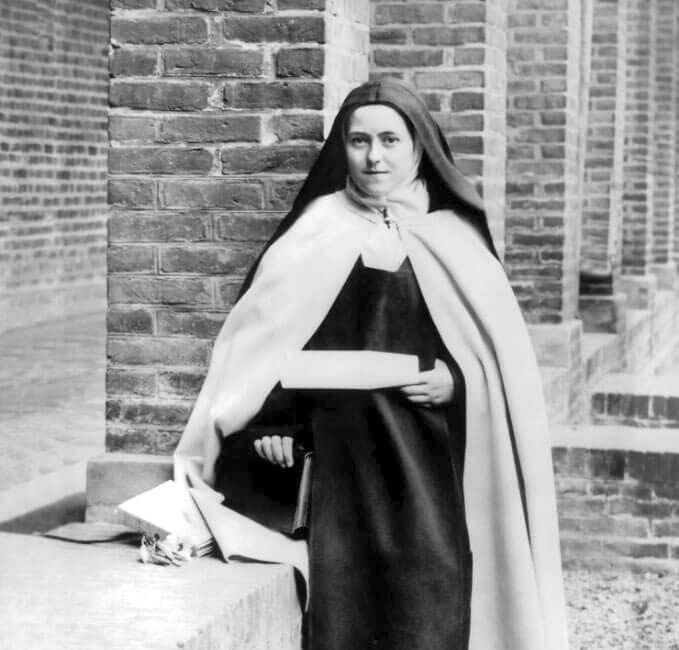
She entered on the ninth of April, 1888, at fifteen, where two of her sisters already lived. Whatever romance the idea had carried lasted about as long as the heavy door took to close behind her. Carmel was cold — one stove for the whole house — and poor, and unrelentingly ordinary: the same prayers, the same silence, the same sweeping and laundry, day after day after day. The food was meager and she was often hungry. The prioress, Mother Marie de Gonzague, was changeable and could be sharp with Thérèse precisely because the younger sisters favored her. No flood of consolation came to reward her sacrifice. She had not come for that. She had come, she said, "to save souls and above all to pray for priests," and she set about it in the dark, with nothing to show for it that any eye could see.
5Her Father's Long Martyrdom
The hardest grief of her life was not her own. Her father, Louis Martin — gentle, devout, the man she called her "king" — began, not long after she entered Carmel, to lose his mind. A series of strokes brought on paranoia, wandering, and terror; once he vanished for days before he was found. In the end the family had to place him in an asylum at Caen, the dignified father of her childhood now a frightened patient among strangers. Thérèse felt the shame of it like a wound — and slowly came to treasure it. She had taken in religion the name Thérèse of the Child Jesus and of the Holy Face, and in her father's ruined, dishonored face she saw the disfigured face of the suffering Christ of Isaiah, "no beauty in him that we should desire him." He died in 1894, after long decline, and she counted those bitter years the most fruitful her family had ever known.
6The Little Way
The trouble she found in the convent was not the cold or the work but her own smallness. She read St. Paul on the higher gifts and longed to be everything at once — apostle, missionary, martyr — and knew she would be none of them. She was not strong, not learned, not destined for anything the world would notice. The weight of wanting to be great with nothing to be great with nearly crushed her.
Her answer came as an image. In those years the first elevators were appearing in the grand houses of Paris, and Thérèse thought: she would never have the strength to climb the rough staircase of perfection the great saints had climbed. But she did not need to. She would be carried. The arms of God were the lift that would raise her, if only she stayed little enough to be picked up. So she gave up trying to do great things and gave herself to small ones done with great love — a kind word to a difficult sister, a chore taken without complaint, a smile when she would rather have wept. This was the "little way," and she was convinced it was a path anyone, however ordinary, could walk to the very heights.
7The Difficult Sisters
The little way was no theory; she practiced it on the people around her, and some of them were hard work. One nun had a habit of making a small clicking noise during the silent prayer that nearly drove Thérèse out of her skin; she taught herself to attend to it as if it were a concert offered to God. Another, working beside her at the laundry, kept flicking dirty water into her face, and Thérèse trained herself not to wipe it off or let a flicker of irritation show. And there was one sister so sour and difficult that nobody could warm to her — so Thérèse resolved to treat her as the one she loved best in the house: seeking her out, smiling at her, doing her small services, so convincingly that the woman asked her one day what it was about her that Thérèse found so attractive. None of it showed on the outside. That was exactly the point.
8The Story of a Soul
We would know almost none of this but for an accident of obedience. Her sister Pauline — now Mother Agnes, and for a time the prioress — asked Thérèse one evening to set down her memories of childhood, mostly to amuse the family. Thérèse obeyed, filling a school notebook by lamplight when her duties were done. Later she was told to write of her life in Carmel and the "little way" she had found. She was working at the last pages in pencil, propped up and dying, when the book finally fell from her hands. After her death the prioress edited the notebooks together and sent a copy, almost as an afterthought, to the other Carmels. They called it The Story of a Soul. It was translated, and translated again, and within a few years was being read all over the world.
9The Night of Nothingness
In the spring of 1896 she woke in the night to a warmth in her mouth and knew, with a strange gladness, that it was blood: the first sign of the tuberculosis that would kill her. But the harder trial was not in her lungs. Almost at the same time a darkness came down over her faith. The heaven she had loved and longed for since childhood went silent and blank; when she tried to think of it, she met only a wall, and behind the wall a mocking voice telling her it was all a dream, that beyond death there was nothing.
She did not lose her faith — she lost the feeling of it, and went on without the feeling. She said she had to be careful not to speak of her hope of heaven too warmly to others, because she no longer felt it herself; she made more acts of faith in that last year, she said, than in all the rest of her life. She wrote the words of the Creed out and carried them next to her heart. And in the dark, unable to feel that any of it was true, she kept choosing to love and to trust — which is, in the end, the whole of the little way, tested to its limit and holding.
10A Shower of Roses
The tuberculosis did its work slowly and with great pain through the summer of 1897. Near the end she could barely draw breath, and still the inner darkness did not lift. She bore it without complaint and even with a strange gaiety, certain that her suffering was being spent for souls she would never meet. On the evening of the thirtieth of September, holding her crucifix, she looked up and breathed, "Oh, I love him… My God, I love you." Those were her last words. She was twenty-four.
She had promised that she would not rest idle in heaven but spend it doing good on earth — "I will let fall a shower of roses." The promise seemed to keep itself at once: the cures and conversions credited to her intercession poured in so fast that Rome canonized her in 1925, fewer than thirty years after her hidden death. She was made patroness of the foreign missions she had never been allowed to enter, and in 1997 a Doctor of the Church, ranked among the greatest teachers of the faith — the girl who, by the world's measure, had done nothing at all.