St. Boniface
An English monk who walked away from a quiet life of books to spend forty years preaching in the German forests — felling a god's oak with an axe, building a church across half a continent, and dying with a book raised over his head.
The Life of St. Boniface in Chapters
1The Boy Who Would Not Stay
He was perhaps five years old when the monks came through, preachers on the road who stopped at the house of his father — a man of standing in with other plans for his clever son. The boy listened to them talk about God and decided, then and there, what he wanted; and once he had decided, nothing moved him. He told his father he meant to be a monk. His father argued, coaxed, and forbade it. The boy simply waited him out. When the man fell suddenly and dangerously ill and read his sickness as a warning, he gave way, and Wynfrith got the life he had set his heart on. He went at it the way he went at everything after — completely. He read everything, wrote a Latin grammar and a book on poetry, and ran the abbey school so well that students came just for him. By every measure England had, he had arrived. That was the moment he chose to leave.
2The First Failure
In 716 he crossed to with a few companions, sure the ground was ready. It was not. War had broken out between , the strongman of the Franks, and Radbod, the pagan king of the Frisians; the priests had scattered, the churches lay wrecked, and the old idols were back in their shrines. Boniface walked the country and even talked his way in to see Radbod himself, and found no opening anywhere. So he went home — beaten, with nothing to show. Within the year his died and the monks of Nursling chose him to take the abbey, the honored and natural end to his story. He said no. The failure did not send him back to safety; it sent him to Rome, to come at the same work again with the whole weight of the Church behind him.
3A New Name
He reached Rome in the autumn of 718 and waited on Pope . The pope questioned him closely — his learning, his morals, his reasons — and, satisfied, gave him the thing he had crossed a continent to ask for: the commission to preach east of the , where no church yet stood. With it came a new name. Gregory called him Boniface, after an old , and the Wynfrith of the schoolroom was gone. On a later visit the pope had him swear an oath of loyalty over the bones of and made him a bishop — a bishop with no city, no cathedral, and no flock yet gathered, sent to a land that had none. He took the letters that put him under the protection of , and turned north again, alone, into the forests.
4The Oak of Thor
At in stood a huge oak sacred to the god the people called Thor, and the country around it was full of baptized Christians who still hedged their bets, slipping back to the old shrines whenever the harvest failed or the sky turned black. Boniface did not try to argue them out of their fear. He announced, ahead of time and in front of a crowd, that he would cut the god’s tree down — and that they should watch and see whether Thor defended it. It was the kind of dare that got men killed, and he made it with an axe in his hands. He swung. The story that came down says a great wind finished the work and tore the oak apart as it fell. The god did nothing. The people who had waited for lightning saw an old tree lying in pieces and a foreigner still on his feet — and that settled it. He had the wood sawn into beams and raised a chapel to on the spot. Later tellers added that the trunk broke into four even parts shaped like a cross, and that a young fir left standing in the wreckage pointed up to heaven; those touches grew with the retelling. What stood at the end of the day was a felled tree and the frame of a new church going up from its wood.
5Hammer and Pope
He could not have lasted a year without two protectors. One was — the Hammer — whose iron grip held the lands together; his letter of protection meant that to lift a hand against Boniface was to answer to Charles. The other was the pope, to whom Boniface reported across the whole length of the mission, sending disciples down to Rome with questions and getting back rulings and encouragement. Guarded at both ends, he spent himself in the middle. He baptized and preached, pulled down shrines and put up churches, planted convents and filled them — and was always short of hands. So he wrote home, a stream of letters back across the begging the abbots and abbesses of England for workers, for prayers, for books. He asked the Eadburga to copy the letters of in gold, so the holy words would carry weight and wonder before pagan eyes that prized gold over argument. England answered. Monks and nuns crossed the sea to him — and some of them, in time, would die at his side.
6The Abbey in the Forest
In 744, in a wild and roadless stretch of forest in , his disciple Sturm found a clearing on the river , and there Boniface raised the abbey that would outlast everything else he built. He meant to be a house of prayer and learning in the heart of the mission field, its monks under the strict , the whole place freed — at his own request — from every bishop’s authority but the pope’s own. He went back whenever he could, to teach the young monks and pray a few quiet days among the trees, and he told them that when he died he wanted to be carried there and buried. Of all the cathedrals and titles he had won, the forest abbey was the place he chose to lie. His bones rest there still.
7The Careful Shepherd
His last great labor was not in the wild country but among the comfortable. The church had grown slack and worldly — bishops who hunted and fought, priests who knew little and cared less, abuses that had hardened into habit. Reforming them took a different nerve than felling an oak: it made enemies of powerful men. Boniface made them anyway, dragging the clergy of Francia back under discipline through council after council and binding them, in writing, to obey Rome. They made him archbishop of for it, of all Germany, the most powerful churchman north of the Alps. Writing to his friend Cuthbert, the archbishop of Canterbury, about the storms breaking over the work, he reached for the picture of a ship in heavy seas and a shepherd who must not run:
Let us be neither dogs that do not bark nor silent onlookers nor paid servants who run away before the wolf. Instead let us be careful shepherds watching over Christ’s flock.
8Dokkum
He was nearly eighty, and the dignity of was his to keep. He gave it up. He handed his office to his disciple Lull, gathered a band of companions, and went back to — to the marsh country where, nearly forty years before, he had failed. This time the work went well. He preached up and down the flat land east of the , baptized many thousands, and pulled down the old shrines, and he called his newest converts to a meadow on the little river Borne, near , to receive on the eve of . He pitched a tent and waited for them in prayer. At dawn a crowd came across the fields — but they carried weapons, and they were not his converts. His servants snatched up arms to defend him. He held them back, telling them the long-awaited day had come, and that Scripture told them to beat evil not with evil but with good:
Cease fighting. Lay down your arms, for we are told in Scripture not to render evil for evil but to overcome evil by good.
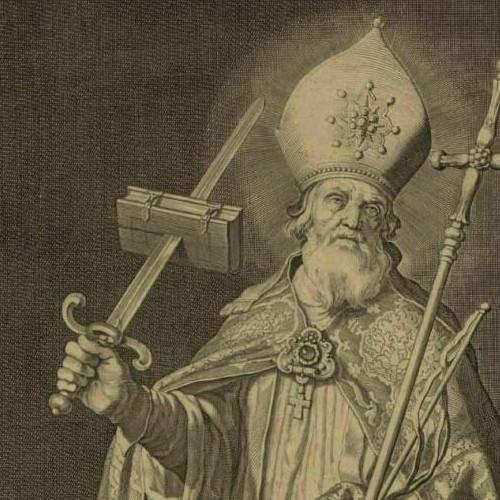
The band fell on them sword in hand. Tradition holds that Boniface raised a book over his head to meet the blow, so the last thing between him and the sword was its pages. They killed him and his whole company, fifty-two men, and ripped open the baggage looking for silver and gold. They found only books and , and scattered them through the reeds.
9The Bloodstained Book
When the Christians crept back to the field they gathered the bodies, and they gathered the books, fishing them out of the marsh-water where the raiders had flung them in disgust. Three were carried to and kept. One of them, a thick book holding among other things a of , has long slashes driven clean through its pages, as if a blade had been stopped by it, and the is dark with old stains. The inside is titled On the Advantage of Death. It is kept at to this day, cut and discolored — the book an unarmed man raised, at the very end, against the sword.