St. Padre Pio of Pietrelcina
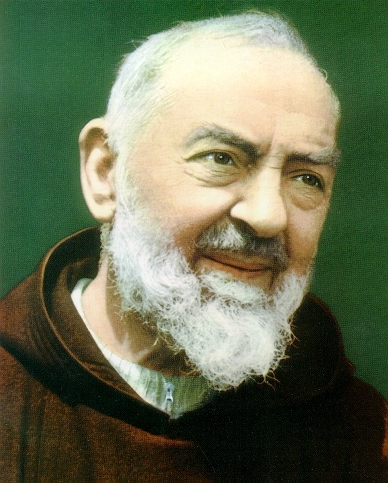
A Capuchin friar from a poor Italian farming village who bore the bleeding wounds of Christ for fifty years and heard confessions from dawn to dusk. Hidden behind fingerless gloves, he told the anxious crowds who found him only: pray, hope, and don't worry.
A Capuchin friar came through Pietrelcina one summer collecting alms, a bearded man in a brown habit and rope sandals, and the boy who watched him could not look away. Francesco Forgione was a farmer's son who had spent his childhood minding a small flock on the family land, a quiet, sickly child who liked to slip off alone to pray and who told his parents, when they asked what he wanted to become, that he wanted to be a friar — a friar with a beard. He had no schooling to speak of; three years of village classes and a decade among the sheep. So his father, Grazio, sailed to America and worked the mills and farms of Pennsylvania to pay for the tutors who would make a friar of his boy, and at fifteen Francesco entered the Capuchin novitiate at Morcone and put on the habit and took a new name. They called him Brother Pio.
He was ordained at twenty-three, in the cathedral at Benevento, and might have disappeared into the ordinary life of a country priest had his body not begun to betray a hidden thing. Within weeks of his first Mass, praying under an elm at the family farm, his hands and feet and side burned with sudden pain and showed the marks of wounds — the wounds of the crucified Christ. He was horrified. He begged to be allowed to suffer in secret, and for a while the marks faded and went away. He fell sick so often and so strangely that he was sent home to his village for years, saying Mass and teaching school, while his superiors wondered what to make of him.
In September of 1916 they sent him at last to a poor friary in the Gargano mountains, Our Lady of Grace, above the dusty town of San Giovanni Rotondo. He arrived a frail, obscure friar of twenty-nine. He never left. For fifty years he lived in that house, and the world came up the mountain to him.
It came because of what happened on the twentieth of September, 1918. Alone in the choir loft after Mass, praying before a crucifix, he felt the wounds open again — and this time they did not close. Blood ran from his hands and feet; a gash in his side bled through his habit. He was the first priest in the history of the Church to bear the stigmata, and he would bear them for half a century, losing, the doctors said, a cup of blood a day. He hid his hands in fingerless gloves and hated to have them looked at. Word travelled anyway. Doctors came to probe the wounds and could not explain them. Then the pilgrims came, and kept coming.
What they found when they reached him was not the spectacle they had imagined but a confessor. He sat in the confessional as much as sixteen hours a day, and the lines stretched out the church door and down into the town, people waiting days for their turn. He could be brusque; he was known to send the falsely contrite away and tell them to come back when they meant it. He seemed to know what a soul had done before it spoke, and to name the sin a penitent was hiding. People left his confessional weeping and changed. To the ones who came weighed down with fear and trouble he gave, again and again, the same plain counsel.
Pray, hope, and don't worry. Worry is useless. God is merciful and will hear your prayer.
Stranger things gathered around him. People in distant cities prayed to him and smelled, in a closed room, the sudden scent of roses or violets where no flower was. Others swore he had appeared to them far from the friary — at a sickbed, in a foreign country, at the side of a dying man — while his brothers knew he had never left his cell. He spoke little of any of it and turned the questions aside.
Not everyone believed. For more than a decade the Holy Office in Rome, fed by the jealousies of local clergy, treated him with deep suspicion. He was investigated, declared to be nothing supernatural, and finally, in 1931, stripped of nearly every priestly faculty — forbidden to say Mass in public, to hear confessions, to answer the letters of the faithful. He obeyed without a word of protest. The will of the superiors, he said, is the will of God. His admirers were less serene; when rumour spread that he would be taken away, the townsmen of San Giovanni Rotondo barricaded the roads and surrounded the friary with guns until the plan was abandoned. The silence lasted two years. Then it lifted, and the crowds came back larger than before.
Out of the suffering that flowed past him he built something solid. He dreamed of a hospital on the mountain, a place where the sick would be cared for in body and in soul, and against every obstacle the money came in from his spiritual children across the world. In 1956 the Casa Sollievo della Sofferenza — the Home for the Relief of Suffering — opened its doors, and he wept at the Mass said before it.
He grew old and bent and short of breath, the wounds still bleeding. On the twenty-third of September, 1968, near half past two in the morning, he died in his cell with a rosary in his hands and two names on his lips. When they came to prepare his body the wounds were gone — the skin of his hands and feet and side unbroken and whole, as though they had never been there at all.