St. Padre Pio of Pietrelcina
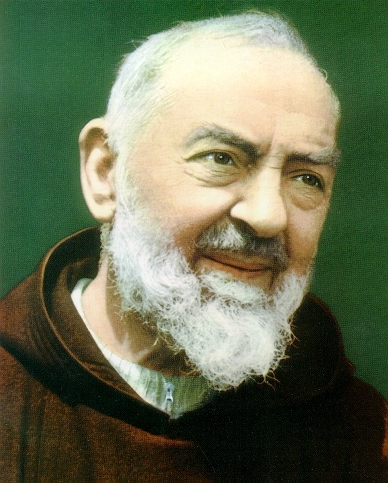
A Capuchin friar from a poor Italian farming village who bore the bleeding wounds of Christ for fifty years and heard confessions from dawn to dusk. Hidden behind fingerless gloves, he told the anxious crowds who found him only: pray, hope, and don't worry.
The Life of St. Padre Pio of Pietrelcina in Chapters
1I Want to Be a Friar with a Beard
He was born on the twenty-fifth of May, 1887, in a stone house in Pietrelcina, and named Francesco for an older brother who had died as a baby. The Forgiones were poor and devout; his mother prayed with the children, his father worked the land and, when it was not enough, the land of others across the ocean. From his earliest years Francesco was different from the boys around him — drawn to the church, given to long silences, troubled by visions he would only later describe, of the Madonna and his guardian angel, and of figures that came to frighten and torment him in the night. He tended the family's few sheep through the heat of the day on the plain called Piana Romana, and learned his letters late and with difficulty. When a Capuchin questor passed through the village, the boy fixed on him, and the wish hardened into a plan. His parents went to Morcone to ask if the friars would take him. They would, the friars said — but the boy would need schooling first. And so his father crossed the Atlantic to earn it.
2The Wounds in Secret
He was ordained on the tenth of August, 1910, in the cathedral at Benevento, a thin young priest of twenty-three with a persistent cough the doctors could not cure. Back home in Pietrelcina, kept from the friary by his fragile health, he said Mass and taught the village children. One day late that summer, praying alone beneath an elm tree at the farm, a sharp pain pierced his hands and feet and the left side of his chest, and red marks rose on the skin. He told almost no one, and confided the rest only to his spiritual director by letter. The thing terrified and shamed him. He asked the Lord to let the visible marks go and to leave him only the pain — to suffer, but in secret, where no one could see and make a wonder of it. The marks faded. For eight more years they would come and go, a private wound, while he prayed that it stay hidden.
3The Mountain Friary
The war pulled even the friars into uniform. He was called up into the Italian medical corps, found too sick to serve, discharged, recalled, and discharged again, until in 1918 the army let him go for good with a diagnosis of ruined lungs. In between, in September of 1916, his superiors sent him up to the friary of Our Lady of Grace, above San Giovanni Rotondo in the bare Gargano hills — a poor house of a handful of friars, hard to reach, a mile of stony track from the town. It was meant to be good for his chest, the mountain air. He taught the young seminarians there and heard the confessions of the local farmers and waited out the war in obscurity. He had no notion, and no one had, that he had arrived at the place where he would spend the next fifty years and where, before long, the whole world would come looking for him.
4September in the Choir Loft
On the morning of the twentieth of September, 1918, the friars had scattered after Mass and Padre Pio stayed behind to pray in the choir loft of the old church, before a large wooden crucifix. What happened there he could barely bring himself to write. A figure appeared, streaming light and blood, and when it withdrew he found his own hands and feet pierced through and his side torn, all of them bleeding and burning with pain.
I saw before me a mysterious person... his hands and feet and side were dripping blood. The sight terrified me. When he disappeared I found that my own hands and feet and side were pierced and dripping blood.
This time the wounds did not close. They would bleed for fifty years. A fellow friar found him and the secret was out; the superiors sent doctor after doctor up the mountain to examine and measure and photograph the marks, and none of them could account for what they saw. He endured the inspections in misery, longing only to cover his hands and be left alone with his pain.
5Dawn to Dusk
The real labour of his life was the confessional, and it nearly swallowed him. As his fame spread the pilgrims arrived by the thousands, sleeping in the open and taking numbered tickets, waiting days for a few minutes with him. He heard confessions for ten, twelve, sometimes sixteen hours in a day, year upon year. He was no soft confessor. He could read the state of a soul before its owner spoke, and would name the sin a penitent meant to leave unsaid, or refuse absolution to the proud and the unrepentant and order them out until they were ready to be honest. Hardened men went in skeptical and came out shaking and wet-faced. He gave penances and demanded amendment, but to the frightened and the grieving he was tender, and he sent them away with the words he repeated all his life: pray, hope, and don't worry. It was here, more than in any miracle, that he spent himself.
6The Perfume and the Two Places
The marvels multiplied around him whether he willed them or not. People who never met him prayed in his name and reported a sudden fragrance with no source — roses, violets, sometimes tobacco — filling a room and then gone; the friars came to call it his perfume, and investigators confirmed he wore no scent and that the strange odour clung even to his blood. Stranger still were the accounts of his appearing in two places at once: at the bedside of the dying, in distant cities, in countries he had never visited, while the brothers of the friary knew for certain he had not left the house. Once a priest who had said Mass in a country church mentioned its two windows, and Padre Pio quietly corrected him — there was a third — though he had never been near the place. He deflected every such story with a shrug or a joke and refused to make himself a wonder, insisting he was only a poor friar who wanted to pray.
7Locked in the Cloister
His fame bred enemies. Local clergy, resentful of the crowds drawn away from their own churches, sent Rome a stream of accusations — fraud, vanity, worse — and the Holy Office took them up. It investigated for years, declared in 1923 that it found nothing supernatural in him, and warned the faithful away. Then, in 1931, it acted hard: Padre Pio was stripped of nearly all his faculties, forbidden to celebrate Mass except alone in an inner chapel, forbidden the confessional, forbidden even to write to those who sought his help. The decree was read to him and he bowed his head. God's will be done, he said. He spent two years walled in silence, saying his lonely Mass, while petitions and pamphlets poured out in his defence — efforts he begged his champions to stop. The town would not be so meek; when word came that he might be carried off to another friary, the men of San Giovanni Rotondo threw up barricades and ringed the walls, armed, day and night, until the threat passed. In 1933 the restrictions were lifted, and the church filled again past its doors.
8A House for the Relief of Suffering
He had watched the sick of the mountains die for want of care, and he meant to build them a hospital. It seemed an impossible thing for a penniless friar in a remote town, but his spiritual children across the world emptied their pockets, and the money came. Ground was cleared on the slope below the friary, and stone by stone a great clinic rose where there had been scrub and rock. On the fifth of May, 1956, the Casa Sollievo della Sofferenza — the Home for the Relief of Suffering — was inaugurated before a crowd of fifteen thousand, with Padre Pio saying Mass in the open air before its doors. He called it not a hospital only but a temple of prayer and science, where the sick might find God in the love of those who tended them. It stands on the mountain still, treating the poor he built it for.
9Jesus, Mary
In his last years the strong frame had bent and the breath came short, and the wounds bled on. On the twenty-second of September, 1968, fifty years almost to the day from the morning in the choir loft, he said his last Mass, so weak he could hardly stand, and afterward sank down exhausted. Through that night his strength ebbed away. He made his confession and renewed his vows and took the rosary into his hands, and near half past two in the morning, with the two names he had spoken all his life — Gesù, Maria — he died. He was eighty-one. When the brothers came to wash and dress the body for burial they uncovered the hands and the feet and the side and stopped: the wounds that had bled for fifty years were closed and gone, the skin smooth and whole, with not so much as a scar to show they had ever been there.