St. Carlo Acutis
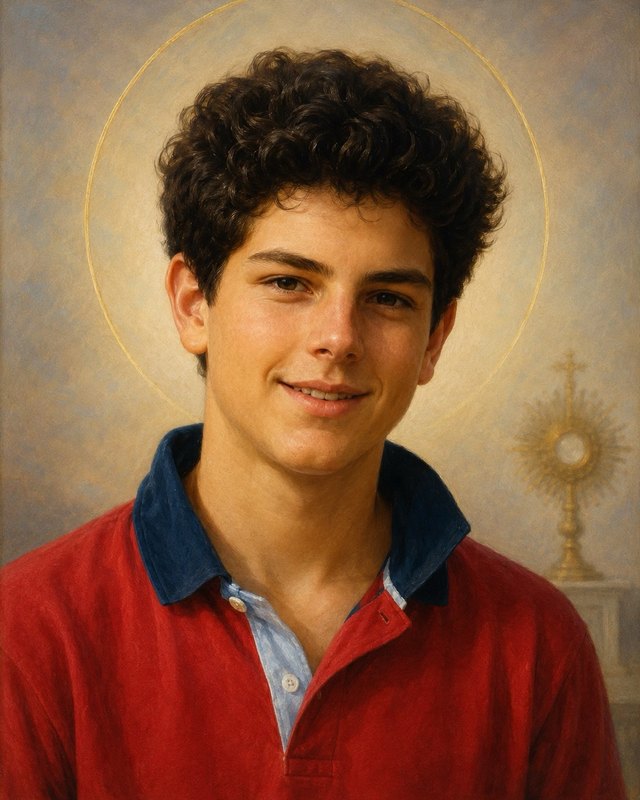
An Italian teenager who loved video games, code, and the Eucharist in equal measure — and built a website cataloguing the world's Eucharistic miracles before dying of leukemia at fifteen. The Church's first millennial saint.
He was three, perhaps four, when he began stopping his mother on the pavements of Milan. Past every church door his small hand would tug toward the dark interior, and on the way home he wanted flowers — a few stems pressed into his fist and laid at the feet of the Virgin in whatever side chapel they passed. His mother, Antonia, had been to Mass only a handful of times in her life and could not say where the boy had learned any of it. There had been a Polish nanny who spoke to him of Jesus; the rest seemed simply to have been in him from the start. By the time he could write he had set it down like a plan for a life: to always be close to Jesus.
He grew up rich and entirely unbothered by it. His father was an insurance man from an old Turin family, his mother a publisher; there were houses and holidays. But when Antonia once suggested a second pair of shoes, the boy refused — one pair worked fine — and saved his pocket money instead to buy a sleeping bag for a homeless man he had befriended on his rounds. Most days he packed up food and carried it out to the people sleeping near his building. He taught catechism to younger children. He sat with classmates whose parents were divorcing and stood up for the ones being bullied. He could not walk a block without stopping to talk to someone; his family half dreaded going out with him, because Carlo knew everyone.
He was also, by any measure, an ordinary Milanese kid of the early 2000s. He played soccer and the saxophone. He had a PlayStation. He loved his dogs and cats and filmed elaborate little movies with them, dubbing in voices. His favorite cartoon was Pokémon. And he was a prodigy at the machine that defined his generation: at eight or nine he got hold of a university computer-science textbook and taught himself to code, then to animate, then to edit film. He built and maintained websites while grown men around him still feared the mouse.
What he did with the gift set him apart. After his First Communion — which he was allowed to receive at seven, so plainly did he want it — Carlo went to Mass every day and stole a few minutes before the tabernacle, often alone, his parents not always with him. It pained him that people would queue for hours outside a stadium and not spare a moment for the altar. So he decided to make the case in the language of his age. Beginning around eleven, he set out to document every approved Eucharistic miracle in the world — Lanciano, Bolsena, the rest — researching each one, then pulling his parents along to the shrines to photograph them, and building the whole archive into a website. It eventually gathered some one hundred and fifty miracles and grew into a travelling exhibit that would one day circle the globe. The Eucharist, he said, was his highway to heaven.
He guarded his hours the way he guarded his soul. Video games he rationed to one hour a week, so as not to become, in his word, a slave to them. Confession he made weekly. He was certain holiness was not a thing for old monks but a thing for him, now, and possible for anyone who simply wanted it enough.
In the first days of October 2006 he came down with what looked like flu. Within a week the diagnosis was acute leukemia, and the doctors held out little hope. He did not rage against it. He offered his suffering for the pope and for the Church, and told his mother not to grieve.
I am happy to die because I have lived my life without wasting a minute on things that don't please God.
He was fifteen. He died on the twelfth of October, and at his own request his body was carried to Assisi, the town of the saint he loved. It lies there now behind glass in jeans and a pair of Nike sneakers, and the pilgrims come in their hundreds of thousands. The website he had built in a back bedroom went on travelling, parish to parish, country to country, long after the boy who made it had gone.