St. Carlo Acutis
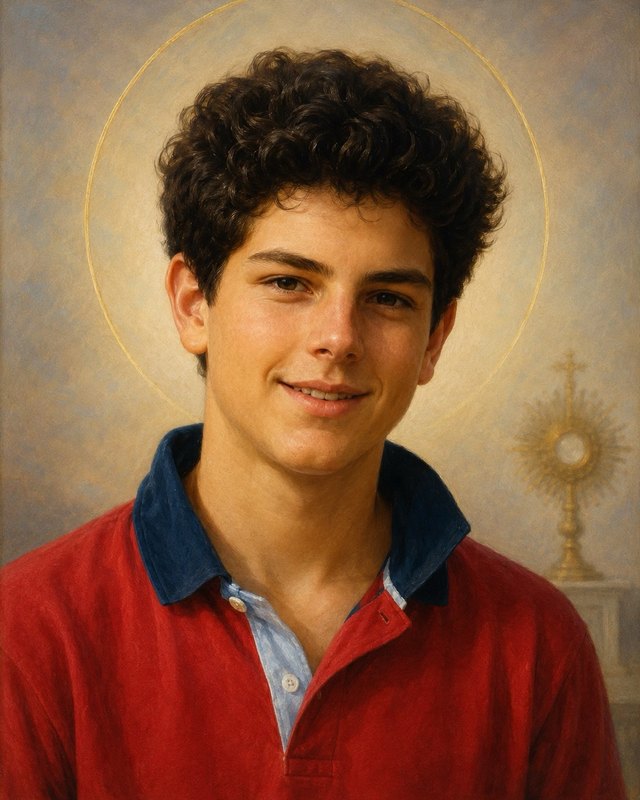
An Italian teenager who loved video games, code, and the Eucharist in equal measure — and built a website cataloguing the world's Eucharistic miracles before dying of leukemia at fifteen. The Church's first millennial saint.
The Life of St. Carlo Acutis in Chapters
1Flowers for the Virgin
Antonia Salzano did not raise a devout child; the child, she always said, raised her. She had attended Mass perhaps three times in her life when her toddler began insisting they go inside every church they passed and buy flowers for the statues of Mary. The questions he asked her about God she could not answer, and the asking sent her, embarrassed, back to study a faith she had never practiced. There had been a nanny from Poland who told him stories of Jesus; the family was nominally Catholic and little more. None of it explained the intensity. He called Mary the only woman in his life and prayed the Rosary every day before he was old enough to be told to. Years later his mother spoke openly of her own return to the faith as something her son had worked in her, the way a small steady light changes a room before anyone notices it has.
2First at the Altar
The custom was to wait until nine or ten, but the priests who knew Carlo could see how badly the boy wanted it, and how seriously he understood it, and so he was granted his First Communion at seven, in a quiet convent chapel at Perego in June of 1998. From that day he went to Mass not on Sundays only but every single day of his life. When the family travelled — and they travelled often, to Marian shrines across Europe — Carlo's first task on arriving anywhere was to find the nearest church and learn its Mass times. Whether his parents came along or not, he would be there. He kept a few minutes of silence before the tabernacle before or after, a daily appointment he refused to break for anything.
3The Highway to Heaven
Everything in Carlo bent toward the Eucharist. He spoke of it constantly, and in images a teenager could feel rather than abstractions a teenager would tune out.
By standing in front of the sun we get a tan, but by standing in front of Jesus in the Eucharist we become saints.
He could not understand the arithmetic of the people around him — that they would wait in line for hours for a concert or a match and not give a moment to the One he believed was truly present a few streets away in every tabernacle in the city. The Eucharist, he said, was his highway to heaven, and the surest, fastest road to holiness for anyone. It was not a phase or a pose. It was the fixed point around which an otherwise completely normal boyhood quietly turned.
4A University Book at Nine
He was a child of the first internet age and fluent in it the way other boys were fluent in football. Somewhere around eight or nine he picked up a university-level manual on computer programming and worked through it on his own, teaching himself to code. From there he moved to 3D animation, to video editing, to building and maintaining websites — skills that, in 2002, most adults did not have. He made short films starring his dogs and cats and dubbed silly voices over them. He kept three computers running when a project called for it, untroubled by the seeming contradiction of a boy who would not own a second pair of shoes. Shoes were a luxury. The machine was a tool, and he meant to use it for something.
5One Hundred Miracles
After his First Communion the thought would not leave him: so few people came to the altar, and he was sure it was only because they did not know what was there. He had read of the Eucharistic miracles the Church had examined and approved over the centuries — the host that became flesh at Lanciano, the bleeding corporal of Bolsena, dozens more scattered across the world — and he became convinced that if people simply saw them gathered in one place, they would not be able to stay away. So he made it his project. He researched each case, and on family trips he steered his parents from one shrine to the next so he could photograph them himself, and he poured the whole of it into a website — eventually around one hundred and fifty miracles, mapped and documented. After his death the archive was printed onto panels and sent out as a travelling exhibition. It has since been shown on every continent, in thousands of parishes, exactly as the eleven-year-old had hoped.
6The Boy Who Knew Everyone
For all the hours at the keyboard, Carlo was no recluse. He was warm and relentlessly friendly, the kind of boy who could not pass a person without stopping to talk, so that walks with him took twice as long as they should. He noticed the ones at the edges — the classmate whose parents were splitting up, the kid being picked on, the disabled man in the neighborhood, the immigrants working in the shops. He carried meals to the homeless near his home and bought one of them a sleeping bag with his own money. A young Hindu man who worked for the family asked to be baptized after living alongside Carlo's faith; others drifted back to a Church they had left. No one felt judged by him, though he was plainly purer than the company he kept. Being near him, his uncle said, simply filled your heart.
7We Are Not Photocopies
He had a horror of a wasted, imitative life. People worry endlessly about the beauty of their bodies, he observed, and not at all about the beauty of their souls.
We are all born as originals, but many die as photocopies.
So he set rules for himself, and kept them. Confession every week. Mass and a few minutes of adoration every day. Video games capped at a single hour a week, lest the thing become his master. He even wrote out a kind of program for becoming holy and posted it, the first instruction of which was the plainest and hardest: a person had to want it with all his heart. Holiness, he was certain, was not the preserve of cloisters and old age. It was available to a teenager with a PlayStation and a website, right where he stood, if only he meant it.
8Five Days in October
At the start of October 2006 he fell ill with what everyone took for the flu. Within days the pain sharpened and the truth came out: acute leukemia, one of the fastest and cruelest kinds, and the doctors gave him almost no chance. He took the news without panic. He asked to receive the Anointing of the Sick and Communion, already certain of where he was going. The suffering he refused to waste like everything else, offering it up for Pope Benedict XVI and for the Church, that he might go straight to heaven. He slipped into a coma after a cerebral hemorrhage, and on the twelfth of October — only days after the first fever — his heart stopped. He was fifteen.
9Jeans and Sneakers
He had asked to be buried in Assisi, drawn since childhood to the poor man of Umbria, and in time his body was brought there and laid in the Church of Santa Maria Maggiore. It rests behind glass, dressed not in robes but in the clothes he died a boy in: jeans, a zip-up top, and a pair of Nike sneakers. A healing in Brazil opened the way to his beatification in 2020, a recovery in Italy to his canonization in 2025, when Pope Leo XIV named him a saint in St. Peter's Square, the first of the millennial generation, with his mother and brother and sister in the crowd. The pilgrims arrive now in the hundreds of thousands — many of them his own age, who had never before queued for an altar — filing past a teenager in sneakers who looks as though he might, at any moment, sit up and ask for his laptop.