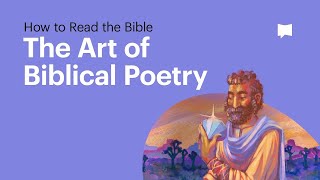
The Art of Biblical Poetry
Topics & people (6)
Summary
About a third of the Bible is ancient Israelite poetry — entire books, most of the prophets, and the majority of God’s recorded speech. Poetry serves a different purpose than narrative: where a story describes an event, a poem ignites the imagination through verbal art. This video introduces the tools of biblical poets — free verse built on carefully worded couplets and large-scale repetition like refrains and inclusios — and encourages readers to slow down and savor poems that hold a surplus of meaning.
Key Points
Poetry is everywhere in the Bible
- Roughly 30 percent of the Bible is poetry; some books are entirely poetry, most Hebrew prophets wrote masterful poems, and most of God’s speech is represented as poetry.
- Narratives often pause while a character breaks into poetic song — as in the Exodus, where the prose account of crossing the sea is followed by a poem about the same event.
Story versus poem
- The narrative states it plainly: “The waters were divided and the Israelites went through on dry land, with a wall of water on their right and on their left.”
- The poem intensifies it: “By the blast of your nostrils, the waters piled up. Surging waters stood like a wall. Deep waters congealed in the heart of the sea.”
- Poetry ignites the imagination through the experience of verbal art rather than simply describing.
Free verse and couplets
- Biblical poems are essentially “free verse” — they don’t use meter or rhyme the way some traditions do, but they have a different kind of order.
- The basic unit is the line; the most basic structure is the couplet — two short lines carefully worded and placed side by side.
- The first line makes a basic statement; the second develops it by completing the thought, deepening it with different words or images, or contrasting it.
- In Psalm 51: the first couplet finishes one thought (asking God for grace and love, then for forgiveness of failures); the next opens with “washing” as a metaphor and deepens it with the image of a priest purifying things for God’s presence; a third couplet contrasts the poet’s inner awareness of sin with its outward, public visibility.
- Couplets are intentionally repetitive, forcing the reader to slow down and view each idea from more than one angle, like a diamond with many facets.
Large-scale repetition
- A key line repeated multiple times throughout a poem is a “refrain.”
- A poem that opens and closes with a similar couplet uses an “inclusio.”
- Poets use repetition to create elaborate patterns that invite readers to connect different parts of the whole poem and uncover deeper layers of meaning.
How to read biblical poetry
- Poetry isn’t something you master and then move past; biblical poems are a bottomless well, packed with a surplus of meaning for those willing to slow down and ponder.
- They are designed to pull the mind in new directions and discover new ideas. (The series notes there is one more poetic tool to explore in the next video.)
Notable Quotes
“The poem ignites your imagination through the experience of verbal art.”
“The repetitive language forces you to slow down and linger over the feeling and meaning of it all, looking at each idea from more than one angle.”
“Biblical poems are a bottomless well. They are packed with a surplus of meaning for those who are willing to slow down and ponder them.”
Let this teach you to linger over biblical poetry — its couplets, refrains, and inclusios — and to treat each poem as a 'bottomless well' that rewards the heart willing to slow down and savor rather than master.
Reflection Questions
- 1
Poems are meant to make you feel something, not just give you facts. Why might God speak to us that way?
- 2
What song or lyric actually makes you feel something? What does it stir up in you?
- 3
What feeling could you bring to God this week using the words of a Psalm?
Meditation Guide
Use this however suits you — quietly on your own, or as an outline for a session. When you come to reflect, turn to the reflection questions above.
- 1
Begin by reading the narrative and poetic versions of the Red Sea crossing side by side, noticing how the plain account and the soaring poem affect you differently.
- 2
Watch the video, attentive to its central idea: that poetry ignites the imagination through verbal art, using couplets and large-scale repetition to hold a surplus of meaning.
- 3
Read the opening couplets of Psalm 51, looking for how each second line completes, deepens, or contrasts the first — like a diamond turned to catch new light.
- 4
Explore the poets' larger tools by finding a refrain or an inclusio in a psalm of your choosing, tracing how the repetition links different parts of the whole.
- 5
Spend time with the reflection questions above, lingering on whichever one speaks to you, and slowly ponder one couplet until it reveals a new angle worth savoring.
- 6
Close in prayer, praying a couplet back to God in your own words and trusting that biblical poems are a 'bottomless well' for the heart willing to slow down.
Up Next in Playlist
How to Read the Bible

How to Read the Bible: An Overview

What Is the Bible?

The Story of the Bible

Writing Styles of the Bible
How the Bible Is Unique as Literature

Plot in Biblical Narrative
Character in Biblical Narrative

Setting in Biblical Narrative

Design Patterns in Biblical Narrative
The Art of Biblical Poetry

Metaphor in Biblical Poetry

The Book of Psalms

How to Read the Prophetic Books

Biblical Law
The Books of Solomon

The Gospel
Why Jesus Told Parables

New Testament Letters: Historical Context
New Testament Letters: Literary Context
How to Read Apocalyptic Literature